

What Are Hair Plugs? This common question often comes from people researching hair loss treatment options. Hair plugs refer to an older hair restoration method that moved groups of hair follicles from a donor area to thinning or bald parts of the scalp. Traditional hair plugs used larger grafts, which could create an uneven appearance. Today, modern hair transplantation uses refined techniques such as FUE hair transplant and FUT hair transplant. These methods focus on natural-looking hair, precise placement, and better hair transplant results.
Understanding What Are Hair Plugs can help you compare traditional hair restoration with today’s surgical hair restoration options. If you have male pattern baldness, thinning hair, bald spots, or a receding hairline, learning how hair plugs work gives you useful background. You’ll also learn about hair grafts, donor hair, recipient areas, recovery, costs, and permanent hair restoration. This guide covers the basics clearly before you consider a hair transplant consultation.
What Are Hair Plugs?
If you’re wondering what are hair plugs, the term usually refers to an older method of hair restoration that moved small groups of hair follicles from one part of the scalp to an area affected by hair loss. Traditional hair plugs typically used larger, round grafts containing several hair follicles. Doctors placed these grafts into small openings in the recipient area.
The goal was straightforward: use healthy donor hair to cover thinning areas, bald spots, or a receding hairline. However, older techniques often produced an obvious, uneven appearance. Modern hair transplantation now uses much smaller grafts that can create more natural-looking hair.
Understanding what are hair plugs also means knowing that the term is often used loosely today. Many people call almost any hair transplant a hair plug transplant, even though modern procedures usually use follicular unit grafts.
Key facts about hair plugs
- Hair plugs are associated with traditional hair restoration methods.
- Older plugs often contained multiple hair follicles.
- Grafts came from a donor area with healthy hair.
- Surgeons moved the grafts into a recipient area.
- Traditional techniques could create a noticeable pattern.
- Modern hair transplant techniques generally use smaller grafts.
- FUE hair transplant procedures remove individual follicular units.
- FUT hair transplant procedures remove a strip of donor scalp.
- Today’s goal is natural-looking hair rather than a plug-like appearance.
So, what are hair plugs in simple terms? They’re an older form of surgical hair restoration that helped address baldness before more refined transplantation techniques became common.
What Are Hair Plugs and How Do They Work?
To understand what are hair plugs, picture moving small patches of grass from a healthy part of a lawn to a bare section. The basic idea is similar. Hair follicles are taken from an area with usable donor hair and placed where additional coverage is needed.
Traditional hair plugs used larger grafts than today’s procedures. Each graft could contain several hair follicles. The surgeon created recipient sites and inserted these grafts into the scalp.
When people ask how hair plugs work, the answer depends on the technique used. Traditional hair plug surgery relied on larger grafts. Modern hair restoration focuses on placing individual follicular units in patterns that follow natural hair growth.
The basic process
- Donor hair is selected: The surgeon identifies healthy hair follicles that can be moved.
- Grafts are harvested: Hair plug grafts are removed from the donor area.
- The recipient area is prepared: Small openings are created where additional hair coverage is needed.
- Grafts are placed: The surgeon inserts the harvested tissue into those openings.
- Healing begins: The scalp gradually recovers while the transplanted follicles establish themselves.
- New growth develops: Transplanted follicles can produce hair after the appropriate growth cycle.
This explains how hair plugs are done at a basic level. The exact process varies according to the procedure, surgeon, graft size, and patient’s hair loss pattern.
Hair Plugs vs Modern Hair Transplant Techniques
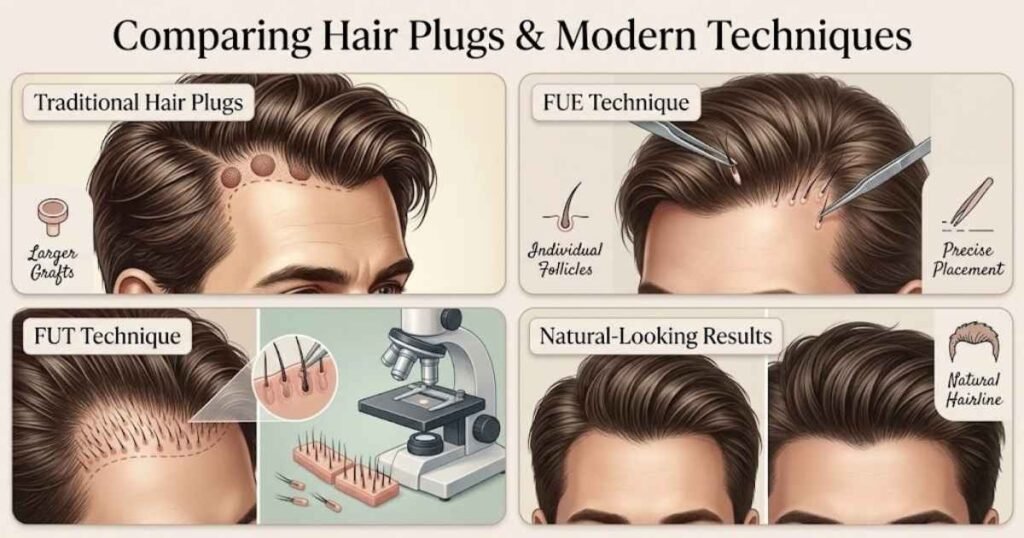
The biggest difference between traditional hair plugs and modern hair transplantation involves graft size, placement, and overall design. Older procedures commonly used larger round grafts. Modern methods focus on smaller follicular units and careful hairline planning.
If you’re comparing hair transplant vs hair plugs, it’s useful to think of them as different generations of hair restoration rather than completely unrelated procedures.
| Feature | Traditional Hair Plugs | Modern Hair Transplant |
| Graft size | Usually larger | Usually smaller |
| Hair follicles per graft | Multiple follicles | Often one to a few follicles |
| Hairline design | Less refined | Carefully planned |
| Appearance | Could look plug-like | Designed for natural-looking hair |
| Common techniques | Traditional grafting | FUE and FUT |
| Placement precision | More limited | Highly controlled |
| Current use | Mostly historical or informal terminology | Widely used for hair restoration |
A modern FUE hair transplant removes individual follicular units from the donor area. A FUT hair transplant removes a strip of scalp and separates it into individual grafts.
That’s whyWhat Are Hair Plugs vs FUE isn’t simply a matter of choosing two identical procedures. FUE represents a more refined approach to follicular unit transplantation.
Likewise, What Are Hair Plugs vs FUT requires understanding that FUT can produce individual follicular unit grafts even though the donor hair is initially removed as a strip.
Why People Choose Hair Plugs for Hair Loss
Although traditional hair plugs are less common today, people still search for hair plugs for baldness and hair plugs for thinning hair because the term remains familiar. Some patients also use hair plugs to describe hair transplantation in general.
What Are Hair Plugs restoration may become an option when hair loss affects your confidence, hairstyle choices, or scalp coverage. Common concerns include male pattern baldness, thinning hair, a widening part, bald spots, and a receding hairline.
Common reasons people consider hair restoration
- Male pattern baldness: Gradual hair loss can affect the temples and crown.
- Thinning hair: Reduced density may make the scalp increasingly visible.
- Receding hairline: Hair restoration can address areas around the front hairline.
- Bald spots: Localized areas may need additional coverage.
- Hairline changes: Some people want to improve the shape or density of their hairline.
- Previous hair loss treatments: Patients may consider surgical options when other approaches haven’t provided the desired coverage.
For people researching hair plugs for receding hairline, modern transplantation can provide more precise placement than traditional plug procedures. The surgeon can consider your existing hair direction, density, facial proportions, and long-term hair loss pattern.
Hair restoration for men and hair restoration for women can involve different planning considerations. Your hair loss pattern, donor hair availability, and overall scalp condition all influence potential treatment options.
How the Hair Plug Procedure Works
Wondering what are hair plugs in relation to the actual surgical process? Traditional hair plug surgery generally involved removing circular grafts containing several hair follicles and placing them into prepared areas of the scalp.
The procedure begins with an assessment of the donor area. Healthy hair follicles need to be available because transplanted hair comes from your own scalp.
Typical stages of a hair plug procedure
Consultation and planning:
A hair transplant consultation helps assess your hair loss pattern, donor density, scalp condition, and treatment goals.
Donor area preparation:
The surgeon identifies an area containing suitable donor hair follicles.
Graft removal:
Traditional methods removed larger groups of follicles as grafts. Modern techniques use more refined harvesting methods.
Recipient site creation:
The surgeon prepares openings in areas affected by hair loss.
Graft placement:
Hair grafts are positioned inside the recipient area according to the planned design.
Initial healing:
The scalp may experience temporary redness, swelling, tenderness, or small crusts.
Hair growth:
Transplanted follicles follow their natural growth cycle. Visible hair transplant results develop gradually rather than overnight.
The goal of modern What Are Hair Plugs transplant surgery is not simply to add hair. Placement matters just as much. A natural hairline needs appropriate direction, spacing, and density.
What to Expect During a Hair Plug Transplant
If you’re considering a hair plug transplant, knowing what happens before, during, and after the procedure can make the experience feel much less mysterious.
During a typical surgical hair restoration appointment, the scalp receives local anesthesia. This numbs the treatment area while you remain awake. The surgical team then harvests donor hair and prepares the recipient area.
Traditional hair plug transplant procedures could involve larger grafts. Modern hair transplantation usually focuses on follicular units for greater control over the final appearance.
During the procedure, you may experience:
- Local anesthesia around the treatment areas
- Donor hair preparation
- Graft harvesting
- Recipient site preparation
- Careful graft placement
- Periodic breaks during longer procedures
- Instructions for protecting the scalp afterward
Afterward, your scalp may feel tender or tight. Mild swelling and redness can occur during the early stages of hair transplant recovery.
Your provider may give specific instructions about washing, sleeping, physical activity, medications, and scalp care. Following those directions helps support proper healing.
What about hair plug healing time?
The hair plug healing time varies from person to person and depends heavily on the technique used. Early scalp healing generally occurs before the transplanted follicles move through their normal growth cycle.
Don’t expect immediate fullness. Hair transplant results develop over time as the follicles enter new growth phases.
How Long Does a Hair Plug Procedure Take?
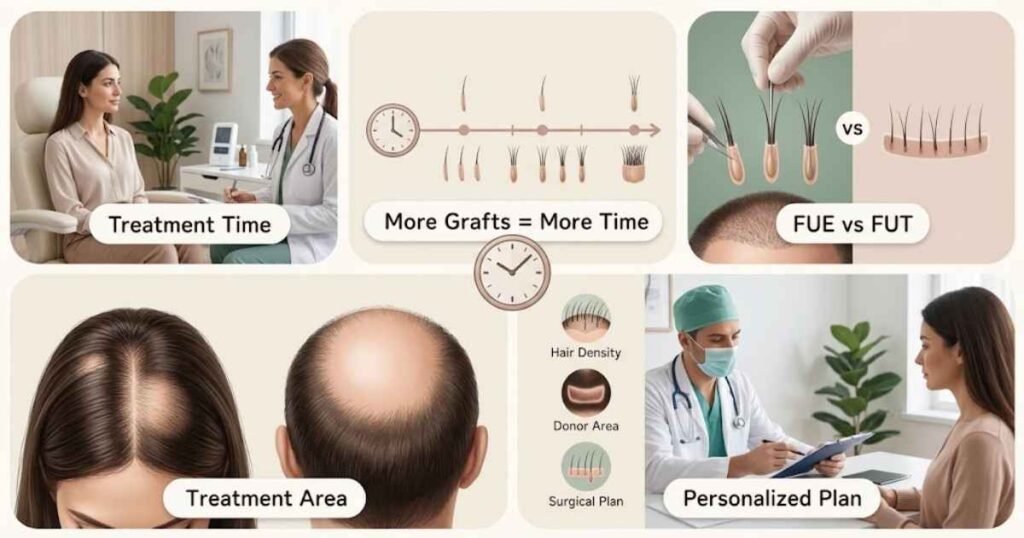
So, how long does a hair plug procedure take? There isn’t one universal answer. Treatment time depends on the number of grafts, the harvesting technique, the size of the treatment area, and the surgical plan.
A smaller procedure may take several hours. Larger hair transplant surgery can require a longer appointment or multiple sessions.
Factors that affect procedure time
| Factor | Why It Matters |
| Number of grafts | More grafts require more harvesting and placement |
| Treatment area | Larger bald areas take longer to cover |
| Graft technique | FUE and FUT involve different harvesting processes |
| Hair density goals | Higher density may require more grafts |
| Donor area | Hair availability affects surgical planning |
| Surgeon technique | Workflows differ between clinics |
| Patient needs | Individual treatment plans can vary |
The phrase hair plug transplant cost also depends on similar factors. In the United States, clinics may calculate pricing based on graft numbers, surgical technique, location, surgeon experience, and the complexity of treatment.
When researching hair plugs cost in the USA, don’t focus only on the advertised price. Ask what the quoted fee includes, how many grafts are planned, which technique will be used, and what follow-up care comes with the procedure.
Ultimately, what are hair plugs becomes easier to understand when you separate the old terminology from modern hair restoration. Traditional hair plugs helped establish surgical approaches to hair loss. Today’s follicular unit transplantation methods offer much finer control over graft size, placement, and hairline design.
What Is Recovery Like After Hair Plug Surgery?
After hair plug surgery, your scalp needs time to settle before you see meaningful growth. Recovery usually happens in stages rather than all at once. Your exact timeline depends on the technique used, the number of grafts, and your individual healing process.
Traditional What Are Hair Plugs may require a recovery period similar to other forms of surgical hair restoration. Modern procedures can involve different levels of scalp irritation depending on whether the surgeon uses FUE or FUT.
What recovery may look like
- First few days: Redness, tenderness, swelling, and small crusts may appear.
- First week: The scalp gradually begins to heal around the treated areas.
- Several weeks: Transplanted hairs may shed temporarily.
- Several months: New natural hair growth can gradually become visible.
- Later months: Hair density and overall appearance continue developing.
During hair plug surgery recovery, follow your provider’s instructions carefully. Avoid scratching the scalp and don’t resume strenuous activities until your medical team says it’s appropriate.
Important: Hair growth takes time. Early shedding doesn’t necessarily mean the treatment failed.
The hair plug healing time also differs between traditional and modern techniques. Your surgeon can give you a more personalized recovery timeline after examining your scalp.
MUST READ: 7 Amazing Mian Tian Sing Hair Salon Services to Try
How Much Do Hair Plugs Cost in the USA?
If you’re researching hair plugs cost in the USA, you’ll quickly notice that prices can vary widely. That’s because clinics don’t all calculate hair restoration costs in the same way.
Today, many providers use the term What Are Hair Plugs informally when discussing hair transplantation. The actual price may depend on the modern technique used rather than the older plug-style procedure.
Factors that influence hair transplant cost
| Cost Factor | How It Affects Price |
| Number of grafts | Larger treatment areas usually require more grafts |
| Technique | FUE and FUT may have different pricing structures |
| Clinic location | Costs can vary between U.S. cities and regions |
| Surgeon experience | Specialist fees can influence the total |
| Hair loss severity | Extensive baldness may require more grafts |
| Treatment sessions | Multiple sessions can increase overall expenses |
| Follow-up care | Some packages include post-treatment appointments |
When comparing hair plugs cost in the USA, ask the clinic for a complete estimate instead of focusing on a single advertised number.
For example, a treatment for a small receding hairline may involve far fewer grafts than extensive scalp hair restoration. Those two patients shouldn’t expect identical pricing.
Your consultation should clarify the planned graft count, procedure type, surgeon fees, facility charges, and follow-up care.
Are Hair Plugs Permanent?
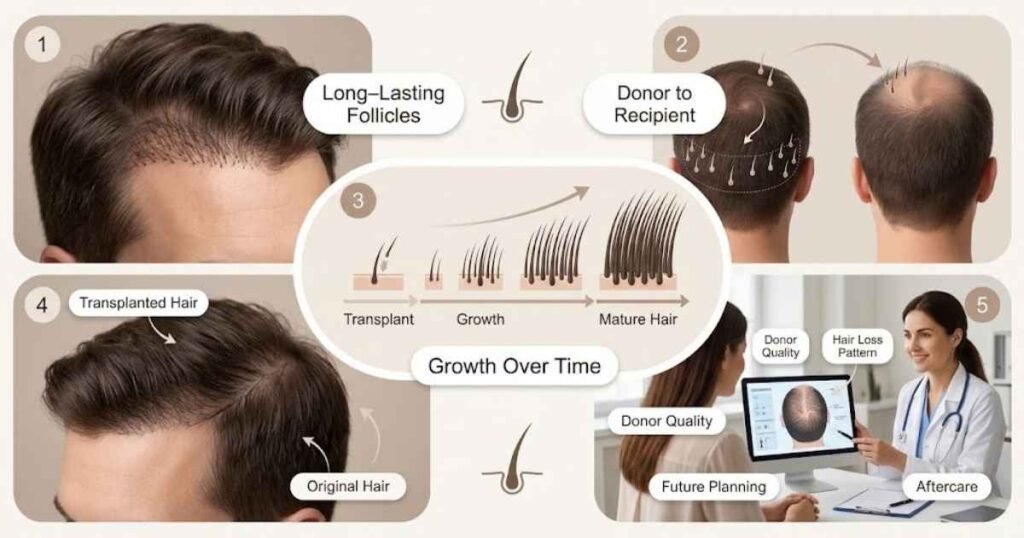
Are hair plugs permanent? The answer depends on the transplanted follicles, your donor area, your underlying hair loss, and the technique used.
Hair transplantation generally moves your own hair follicles from a donor area to a recipient area. When those follicles survive and continue producing hair, they can provide long-lasting coverage.
However, permanent hair restoration doesn’t mean you’ll never experience additional hair loss. Your original, non-transplanted hair can continue thinning over time.
Several factors affect long-term results:
- Quality of the donor hair
- Stability of the donor area
- Pattern and progression of hair loss
- Age and future hair loss
- Surgical technique
- Graft handling
- Post-procedure care
- Overall scalp health
This distinction matters when discussing hair plugs. A transplanted follicle can remain productive while surrounding untreated hair continues to change.
That’s why a surgeon may consider both your current hair loss and your potential future pattern before planning hair transplantation.
What Results Can You Expect From Hair Plugs?
When people ask what are hair plugs and whether they produce good results, appearance remains one of the biggest concerns. Traditional hair plugs could create a noticeable, clustered pattern because surgeons placed larger grafts into the scalp.
Modern hair restoration takes a different approach. Smaller follicular units allow surgeons to control spacing, direction, and density more precisely.
Your potential hair transplant results depend on:
- Number and quality of available donor hair follicles
- Size of the treatment area
- Existing hair density
- Hair characteristics such as thickness and texture
- Surgical technique
- Graft survival
- Natural hair growth cycle
The first visible results won’t represent your final outcome. Transplanted hair often needs months to develop meaningful density.
For people researching hair plugs for baldness, the realistic goal isn’t necessarily a completely full head of hair. Surgeons often focus on improving coverage while using donor hair efficiently.
Traditional vs modern appearance
| Traditional Hair Plugs | Modern Hair Restoration |
| Larger grafts | Smaller follicular units |
| More noticeable clustering | More controlled spacing |
| Less refined hairline design | Detailed hairline planning |
| Plug-like appearance could occur | Designed for natural-looking hair |
| Older surgical approach | Current transplantation techniques |
Modern hair transplant results can look much more natural when the procedure suits the patient’s hair loss pattern and donor supply.
Common Risks and Side Effects of Hair Plugs
Every surgical hair restoration procedure carries potential risks. Understanding them helps you make informed decisions before undergoing treatment.
Traditional What Are Hair Plugs and modern hair transplantation can have different risk profiles depending on the technique and individual circumstances.
Possible side effects include:
- Temporary scalp redness
- Swelling
- Tenderness or discomfort
- Scabbing or crusting
- Itching during healing
- Temporary shedding
- Infection
- Bleeding
- Scarring
- Poor graft growth
- Uneven density
- An unnatural hairline
- Changes in scalp sensation
Some people may also experience shock loss, which refers to temporary shedding of existing hair around the treated area.
The appearance of traditional What Are Hair Plugs can create another concern. Larger grafts may look less natural when they’re placed too closely together or arranged without careful attention to normal hair growth patterns.
Modern hair restoration surgery aims to reduce this problem through refined graft preparation and strategic placement. Still, results depend on the surgeon, technique, donor supply, and individual healing.
Always discuss potential complications during your hair transplant consultation and ask how the clinic handles unexpected problems.
Who Is a Good Candidate for Hair Plugs?
Not everyone with thinning hair needs surgical treatment. Hair transplant eligibility depends on several factors, including your type of hair loss and the amount of usable donor hair available.
If you’re considering What Are Hair Plugs for thinning hair, a specialist should first determine why you’re losing hair. Different causes may require different approaches.
You may be considered for hair restoration if you have:
- Stable or predictable hair loss
- Adequate donor hair follicles
- A healthy scalp
- Realistic expectations
- Areas of thinning that could benefit from additional coverage
- Male pattern baldness or certain other forms of permanent hair loss
- A receding hairline that you want to address
Age alone doesn’t determine whether someone qualifies. A younger person with rapidly progressing hair loss may need careful planning before undergoing surgical treatment.
Hair restoration for men and women
Hair restoration for men often focuses on male pattern baldness, temple recession, crown thinning, or a receding hairline.
Hair restoration for women can involve diffuse thinning, widening parts, or localized density concerns. However, female hair loss can have many causes, so proper evaluation matters.
A qualified specialist can assess your donor density, hair follicles, scalp condition, and expected future hair loss before recommending a procedure.
The key question isn’t simply what are hair plugs or whether you want them. It’s whether surgical hair restoration makes sense for your particular pattern of hair loss.
Modern Alternatives to Traditional Hair Plugs
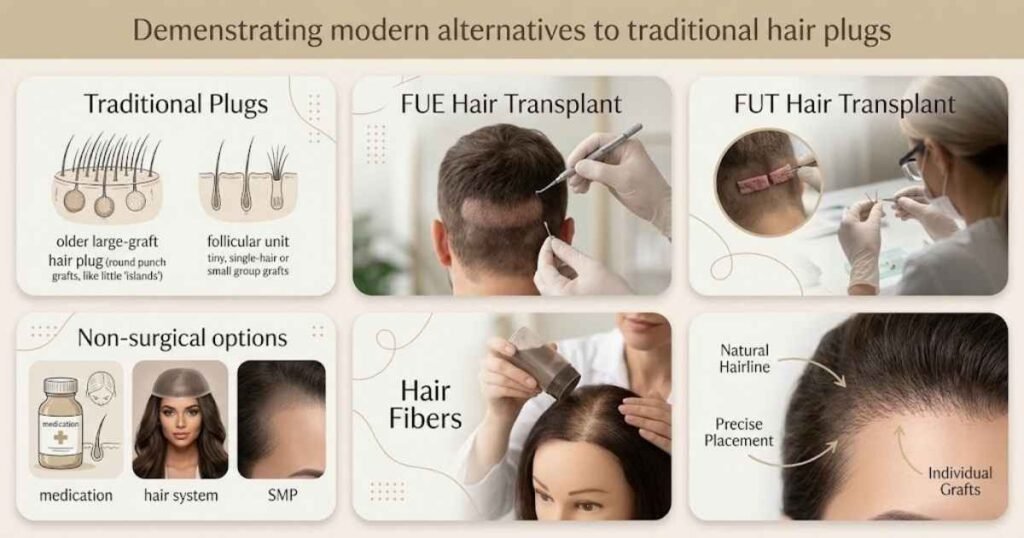
Modern hair restoration has moved far beyond the old-fashioned hair plugs many people remember. Instead of relying on large grafts, today’s procedures often use individual follicular units.
If you’re comparing hair plugs vs FUE or hair plugs vs FUT, the main distinction involves how surgeons harvest and prepare the donor hair.
FUE Hair Transplant
A FUE hair transplant removes individual follicular units from the donor area. The surgeon then places those grafts into prepared recipient sites.
Common features include:
- Individual follicular unit harvesting
- Small extraction sites
- Detailed graft placement
- Flexible treatment planning
- Natural hairline design
FUT Hair Transplant
A FUT hair transplant removes a narrow strip of donor scalp. The surgical team then separates that tissue into individual follicular unit grafts.
Common features include:
- Strip-based donor harvesting
- Individual graft preparation
- Efficient collection of multiple grafts
- Linear donor-area scarring
- Strategic recipient-site placement
Other hair restoration options
Depending on your situation, a specialist may also discuss non-surgical approaches or other hair replacement solutions.
| Option | General Approach |
| FUE | Individual follicular unit extraction |
| FUT | Strip harvesting followed by graft separation |
| Medication | Helps manage certain forms of hair loss |
| Hair systems | Provides cosmetic coverage without surgery |
| Scalp micropigmentation | Creates the appearance of added scalp density |
| Hair fibers | Temporarily conceal visible thinning |
| Traditional hair plugs | Older grafting approach |
Modern hair transplant techniques focus heavily on natural hair growth patterns. Surgeons can place smaller grafts along the hairline and use denser graft placement farther behind it.
For someone researching what are hair plugs, this distinction is important. The phrase usually describes an older technique, while modern hair transplantation commonly refers to refined follicular unit procedures such as FUE and FUT.
Ultimately, your available donor hair, hair loss pattern, scalp condition, and long-term goals determine which hair restoration options may be appropriate.
FAQ’s
How Do Traditional Hair Plugs Work?
What Are Hair Plugs? They move larger groups of hair follicles from donor areas into thinning scalp regions.
Are Traditional Hair Plugs Permanent?
What Are Hair Plugs? Transplanted follicles may provide lasting growth, although surrounding untreated hair can continue thinning.
Do Hair Plugs Look Natural?
What Are Hair Plugs? Older techniques could appear noticeable, while modern transplantation creates more natural-looking hair.
How Long Does Hair Plug Recovery Take?
What Are Hair Plugs? Recovery varies by technique, graft count, healing response, and specific aftercare instructions.
How Much Do Hair Plugs Cost?
What Are Hair Plugs? Costs vary based on graft numbers, technique, clinic location, surgeon, and treatment complexity.
Conclusion
Understanding What Are Hair Plugs gives you a clearer view of how older hair restoration procedures worked. Traditional hair plugs moved larger groups of hair follicles into areas affected by hair loss. Although this approach helped many people seek coverage, modern hair transplantation now offers more refined options. FUE hair transplant and FUT hair transplant techniques use carefully prepared hair grafts to create more natural-looking hair. Your donor hair, recipient area, hair loss pattern, and treatment goals all influence the approach.
For anyone considering hair restoration, learning What Are Hair Plugs is only the starting point. You should also understand hair transplant recovery, potential side effects, hair transplant cost, and expected hair transplant results. A professional consultation can help assess your healthy hair follicles and available donor supply. With the right information, you can better understand today’s hair restoration options and decide which questions to discuss with a qualified hair restoration specialist.

HairVist is a helpful destination for hair care tips, hairstyle ideas, and beauty inspiration, managed by Ava Reynolds, an SEO content writer with 2 years of experience, focused on creating simple, useful, and engaging content that helps readers learn more about hair care and styling.
1 thought on “10 Simple What Are Hair Plugs? A Guide to Hair Transplants”