

Burnt hair can feel rough, look dull, and become difficult to manage. Excessive heat styling, chemical treatments, and accidental burns can damage your hair’s outer protective layer. Once that happens, strands may lose moisture, become brittle, and break more easily.
The good news? You can improve the appearance and manageability of burnt hair with the right care routine. Although severely damaged strands cannot fully repair themselves, moisturizing treatments, nourishing oils, and bond repair products can make a noticeable difference. You can also prevent additional damage while healthier hair grows.
Whether your hair suffered from a flat iron, curling wand, bleach, or another treatment, understanding the cause helps you choose the right solution. Let’s look at practical ways to treat burnt hair at home and restore softness, shine, and strength.
What Causes Burnt Hair and How to Recognize It
Burnt hair usually develops when excessive heat or harsh chemical treatments weaken the hair’s natural structure. Your hair’s cuticle acts like a protective shield. When heat or chemicals damage this layer, strands struggle to retain moisture and become increasingly fragile.
Understanding what caused the damage is the first step toward effective damaged hair repair.
Common causes of burnt hair
- Excessive flat iron use: Frequent straightening at high temperatures weakens the cuticle and causes thermal damage.
- Curling iron damage: Holding hot tools against the same section for too long can leave strands dry and brittle.
- Blow-dryer overheating: Using concentrated heat without proper distance or movement can damage delicate hair fibers.
- Hair bleaching: Strong lightening chemicals remove natural pigment and can weaken the hair structure.
- Chemical treatments: Relaxers, perms, and repeated coloring may cause chemical hair damage.
- Overlapping treatments: Combining bleach, permanent color, and keratin treatment can leave hair overprocessed.
- Lack of heat protection: Skipping heat protectant spray increases the risk of damage during styling.
- Poor hair maintenance: Inadequate conditioning and excessive washing can worsen dryness.
How to recognize burnt hair
Look for these common warning signs:
- Rough texture that feels unusually coarse.
- Dry and brittle hair that lacks natural softness.
- Frizz that remains even after conditioning.
- White dots or visible damage along individual strands.
- Split ends and frequent hair breakage.
- Hair that tangles easily after washing.
- Reduced elasticity when gently stretching a wet strand.
- Dull appearance without its usual shine.
- Uneven texture after bleaching or heat styling.
One important distinction: damaged hair and a burnt scalp aren’t the same problem. If heat causes scalp burns, blistering, or significant pain, seek medical attention rather than relying on home hair treatments.
Common Signs and Symptoms of Burnt Hair
Burnt hair doesn’t always look severely damaged at first. Sometimes, the earliest changes appear as dryness, tangling, or a rough texture.
Recognizing these symptoms early helps you prevent additional breakage and choose suitable damaged hair treatment options.
| Sign or symptom | What it means |
| Excessive dryness | Hair struggles to retain moisture |
| Frizzy texture | Damaged cuticles allow moisture fluctuations |
| Split ends | Hair fibers have started separating |
| Frequent breakage | Weak strands cannot handle normal stress |
| Dull appearance | Damaged surfaces reflect less light |
| Rough texture | Cuticle damage creates an uneven surface |
| Poor elasticity | Hair stretches less effectively or snaps easily |
| Tangling | Damaged strands catch against each other |
Other noticeable changes include:
- Hair feels stiff instead of flexible.
- Ends appear thinner than the roots.
- Wet hair stretches excessively or breaks quickly.
- Your usual hairstyle becomes harder to maintain.
- Hair loses its smoothness after shampooing.
- Certain sections feel more damaged than others.
Not every symptom indicates severe thermal damage. For example, dryness can also result from weather, frequent washing, or unsuitable hair products.
If several symptoms appear together, consider adjusting your hair care routine before the damage becomes worse.
How to Fix Burnt Hair at Home Naturally
You don’t always need expensive salon treatments to improve damaged hair. A consistent home routine can restore softness, reduce friction, and make damaged strands easier to manage.
However, remember that burnt hair cannot regenerate its original structure. Home treatments mainly improve its condition and protect remaining hair fibers.
Follow these simple steps to improve damaged hair naturally.
- Stop using heat tools: Give your hair a break from straighteners, curling irons, and hot blow-dryers.
- Choose a moisturizing shampoo: Use a gentle sulfate-free shampoo that cleans without leaving strands excessively dry.
- Apply deep conditioner: Coat your mid-lengths and ends with a nourishing deep conditioning treatment.
- Use a leave-in conditioner: Apply it after washing to improve softness and reduce tangling.
- Try natural hair treatments: Ingredients such as aloe vera and shea butter can support moisture retention.
- Apply a lightweight hair serum: Smooth a small amount over dry ends to control frizz.
- Avoid rough brushing: Detangle gently with a wide-tooth comb, starting from the ends.
- Protect your hair overnight: Use a satin pillowcase or loose protective hairstyle to reduce friction.
Build a simple weekly recovery routine
| Frequency | Hair care activity |
| 2–3 times weekly | Wash when your scalp needs cleansing |
| Every wash | Apply moisturizing conditioner |
| Once weekly | Use a deep conditioning mask |
| Once weekly or as needed | Apply a suitable hair repair treatment |
| After washing | Use leave-in conditioner |
| Every night | Protect hair from friction |
Consistency matters more than using multiple products simultaneously. Give your routine several weeks before judging its results.
Best Home Remedies for Burnt Hair Repair

Natural ingredients can help improve the appearance of damaged hair without making your routine complicated. Many household ingredients contain moisturizing or conditioning properties that soften rough strands.
Still, choose remedies carefully. Natural doesn’t automatically mean safe for every hair type. Always perform a small patch test before applying a new ingredient.
1. Aloe Vera Treatment
Aloe vera provides lightweight moisture and helps hair feel smoother. Its gel also works well in simple homemade conditioning treatments.
- Extract fresh aloe vera gel from a clean leaf.
- Apply a small amount to damp hair.
- Leave it for 15–20 minutes.
- Rinse thoroughly with lukewarm water.
2. Coconut Milk Hair Treatment
Coconut milk contains fats that can help soften dry hair. It works as a temporary conditioning treatment for rough, damaged strands.
- Apply a small amount of plain coconut milk.
- Distribute it through your mid-lengths and ends.
- Leave it for 15–20 minutes.
- Wash with a gentle moisturizing shampoo.
3. Honey and Conditioner Treatment
Honey acts as a humectant, helping attract and retain moisture. Mixing it with conditioner creates a simple treatment for dry and brittle hair.
- Mix one teaspoon of honey with two tablespoons of conditioner.
- Apply the mixture to damp hair.
- Leave it for 15 minutes.
- Rinse thoroughly without scrubbing.
4. Shea Butter Conditioning Treatment
Shea butter contains emollients that help soften rough hair. Its richer texture makes it particularly useful for thick, coarse, or curly hair.
- Take a small amount of shea butter.
- Warm it between your palms.
- Apply lightly to dry ends.
- Wash out if your hair feels heavy.
5. Plain Yogurt Conditioning Mask
Plain yogurt provides a creamy texture that can help coat dry strands. It offers temporary softness rather than rebuilding damaged hair fibers.
- Take two tablespoons of plain yogurt.
- Apply it to your hair lengths.
- Leave it for 10–15 minutes.
- Rinse with cool or lukewarm water.
Which home remedy should you choose?
| Home remedy | Main benefit | Best suited for |
| Aloe vera | Lightweight conditioning | Fine or slightly dry hair |
| Coconut milk | Softness and moisture | Dry hair |
| Honey and conditioner | Moisture retention | Rough strands |
| Shea butter | Rich conditioning | Thick, coarse hair |
| Plain yogurt | Temporary softness | Dry hair lengths |
Avoid applying kitchen remedies to an irritated or burned scalp. Also, don’t expect these treatments to reverse severe damaged hair or permanently repair split ends.
How to Repair Burnt Hair From Heat Styling Tools
Flat irons, curling wands, and blow-dryers can transform your hairstyle in minutes. Unfortunately, repeated exposure to high temperatures can weaken your hair’s protective cuticle.
If you’re wondering how to repair hair damaged by straighteners, start by reducing heat exposure. Your hair needs a break before you introduce another styling routine.
1. Stop frequent heat styling
Avoid straighteners and curling irons for several weeks if possible. Let your strands dry naturally whenever practical.
2. Use a bond repair treatment
Bond repair products target certain structural connections within damaged hair. They can improve strength, manageability, and the appearance of chemically or thermally damaged strands.
3. Apply a deep conditioning treatment
Use a moisturizing mask once weekly. Concentrate on your mid-lengths and ends because these areas often experience the most damage.
4. Choose a leave-in conditioner
A lightweight leave-in conditioner helps reduce friction during brushing. It also makes rough strands easier to manage.
5. Protect your hair before future styling
When you return to heat styling, follow these precautions:
- Apply heat protectant spray before using hot tools.
- Select the lowest effective temperature.
- Avoid repeatedly passing the iron over one section.
- Never straighten soaking-wet hair.
- Use clean styling tools without product buildup.
- Limit heat styling to occasional use.
6. Avoid additional chemical treatments
Don’t immediately combine damaged hair with bleaching, relaxing, or permanent coloring. Give your strands time to recover before considering another chemical service.
If you’re dealing with severely damaged hair a professional stylist can assess the damage and recommend suitable salon hair repair treatment options.
Best Hair Masks for Dry and Burnt Hair
A good hair mask can make damaged hair feel softer, smoother, and easier to style. Unlike ordinary conditioners, deep conditioning masks usually provide more concentrated conditioning ingredients.
However, not every mask works for every hair type. Some formulas focus on moisture while others target weakness or chemical damage.
Five useful types of hair masks
| Hair mask type | Main ingredients | Benefits |
| Moisturizing mask | Shea butter, glycerin | Softens dry strands |
| Protein-rich mask | Hydrolyzed proteins | Temporarily strengthens damaged fibers |
| Bond repair mask | Bond-building ingredients | Supports damaged hair structure |
| Nourishing mask | Argan oil, plant oils | Improves softness and shine |
| Hydrating mask | Aloe vera, humectants | Helps improve moisture retention |
How to choose the best hair mask for damaged hair
- For extremely dry hair: Choose a rich deep conditioning mask with shea butter.
- For weak strands: Consider a protein-rich hair mask when your hair needs strengthening.
- For overprocessed hair: Look for bond repair treatment formulas.
- For frizzy damaged hair: Choose masks containing conditioning agents and nourishing oils.
- For fine hair: Select lightweight formulas that won’t leave heavy residue.
How to apply a hair repair mask
- Wash your hair with a gentle moisturizing shampoo.
- Remove excess water using a soft microfiber towel.
- Divide your hair into manageable sections.
- Apply the mask from mid-lengths to ends.
- Follow the product’s recommended waiting time.
- Rinse thoroughly and avoid unnecessary rubbing.
Most people benefit from using a deep conditioning mask once weekly. However, follow the product instructions and adjust according to your hair’s needs.
If your hair feels stiff after repeated protein treatments, switch to a moisturizing formula. Too much protein can make some hair types feel less flexible.
Natural Oils That Help Repair Burnt Hair

Natural oils can make damaged hair look smoother and feel less rough. They help reduce friction, improve softness, and protect the surface of damaged strands.
However, oils cannot rebuild destroyed hair fibers. Think of them as protective finishing products rather than permanent repair solutions.
Best oils for damaged hair
1. Coconut Oil
Coconut oil contains lauric acid and has research supporting its ability to reduce protein loss in hair under certain conditions.
- Apply a small amount before shampooing.
- Focus on dry mid-lengths and ends.
- Leave it for 20–30 minutes if tolerated.
- Wash thoroughly to remove excess oil.
2. Argan Oil
Argan oil contains fatty acids and vitamin E. It helps smooth frizz and adds shine without requiring a complicated application process.
- Rub two or three drops between your palms.
- Smooth over damp or dry ends.
- Avoid applying too much near the roots.
3. Jojoba Oil
Jojoba oil has a lightweight feel that suits people who dislike heavy hair products.
- Apply a few drops to dry ends.
- Use it after conditioning.
- Adjust the quantity according to your hair thickness.
4. Olive Oil
Olive oil offers rich conditioning for coarse and particularly dry strands. However, its heavier texture may overwhelm fine hair.
- Warm a small amount between your hands.
- Apply sparingly to the lengths.
- Leave it for 20 minutes before shampooing.
5. Sweet Almond Oil
Sweet almond oil helps soften rough strands and improve hair manageability.
- Apply a small amount to your ends.
- Distribute evenly with your fingers.
- Wash out if your hair feels greasy.
Oil comparison for damaged hair
| Natural oil | Texture | Best use |
| Coconut oil | Medium to rich | Pre-shampoo treatment |
| Argan oil | Lightweight | Frizz control and shine |
| Jojoba oil | Lightweight | Dry ends |
| Olive oil | Heavy | Coarse, dry hair |
| Sweet almond oil | Medium | Softness and conditioning |
Choose one oil first instead of combining several. A small amount often works better than coating your entire head.
MORE READ: 10 Best The Hair Shop: Wigs, Hair Extensions, Products, Prices, and Buying Guide
How to Restore Moisture to Burnt Hair
Moisture loss is one of the biggest challenges when dealing with damaged hair. Damaged cuticles struggle to protect the inner hair structure. As a result, strands may feel rough, appear dull, and develop excessive frizz.
The right hair hydration routine can improve softness and make damaged hair easier to handle.
Follow these moisture-restoring steps:
- Switch to moisturizing shampoo: Choose a gentle shampoo designed for dry or damaged hair.
- Condition after every wash: Use a rich conditioner to soften rough strands and reduce tangling.
- Apply weekly hair masks: A deep conditioning treatment helps improve moisture retention and manageability.
- Use leave-in conditioner: Apply a lightweight formula to damp hair for lasting softness.
- Seal dry ends: A few drops of argan oil can help smooth rough-looking ends.
- Avoid hot water: Wash with lukewarm water to prevent unnecessary dryness.
- Reduce washing frequency when appropriate: Wash according to your scalp’s oiliness and cleansing needs.
- Protect hair while sleeping: Satin pillowcases can reduce friction and tangling.
Foods that support healthy hair growth
Your hair also benefits from balanced nutrition. Hair follicles need adequate nutrients to produce healthy new strands.
Include these foods in your regular meals:
| Food | Helpful nutrients |
| Eggs | Protein and biotin |
| Salmon | Protein and omega-3 fats |
| Spinach | Folate and iron |
| Almonds | Vitamin E |
| Greek yogurt | Protein and vitamin B12 |
| Sweet potatoes | Beta-carotene |
| Lentils | Protein and iron |
A balanced diet supports normal hair growth. However, food cannot reverse existing hair cuticle damage or replace professional treatment when necessary.
For better results, combine proper nutrition with consistent conditioning and gentle styling habits.
Best Hair Care Products for Burnt Hair
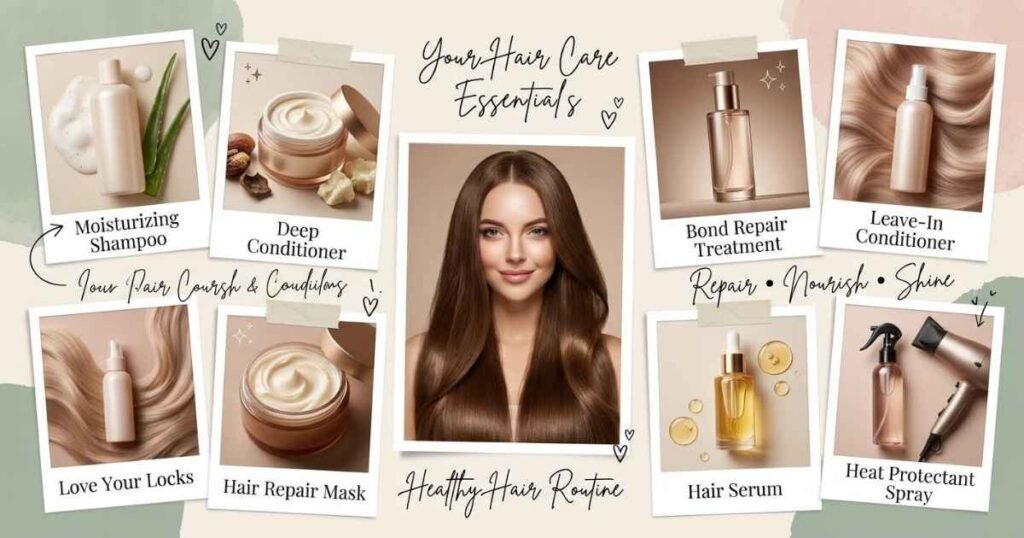
Choosing suitable products can make a major difference in your damaged hair recovery routine. You don’t need an overflowing bathroom shelf. A few well-formulated products can address dryness, breakage, frizz, and weakness.
When shopping for the best products for damaged hair in the USA, focus on ingredients and your hair’s actual needs.
1. Moisturizing Shampoo
A moisturizing shampoo cleans your scalp while helping reduce the dry feeling associated with damaged strands.
Look for:
- Glycerin
- Panthenol
- Aloe vera
- Conditioning ingredients
- Mild cleansing agents
A sulfate-free shampoo can work well if your hair feels particularly dry. However, sulfates aren’t automatically harmful to everyone.
2. Deep Conditioner
A quality deep conditioner helps soften rough strands and improve manageability.
Look for shea butter, fatty alcohols, glycerin, and conditioning agents. These ingredients can help reduce friction and make detangling easier.
3. Bond Repair Treatment
Bond repair products target specific structural connections within damaged hair fibers. They can be especially useful after repeated bleaching or excessive heat styling.
Choose a formula designed for your hair’s level of damage. Follow its instructions carefully.
4. Leave-In Conditioner
A leave-in conditioner provides additional conditioning between washes. It also helps reduce friction when brushing or styling.
Choose lightweight formulas for fine hair and richer creams for thick or curly textures.
5. Hair Repair Mask
A hair repair mask provides concentrated conditioning for dry and brittle hair.
Consider products containing:
- Hydrolyzed proteins
- Shea butter
- Argan oil
- Ceramides
- Glycerin
- Panthenol
6. Hair Serum
A silicone-based or oil-based hair serum can smooth the appearance of frizzy damaged hair. It also adds shine and makes rough ends look more polished.
7. Heat Protectant Spray
If you eventually return to heat styling, use a suitable heat protectant. It helps reduce thermal damage when applied correctly, although it cannot eliminate the risk completely.
Popular hair repair products available in the USA
Here are some established product options worth considering:
| Product | Main purpose |
| Olaplex No. 3 Hair Perfector | Bond-focused hair treatment |
| K18 Leave-In Molecular Repair Hair Mask | Leave-in damage treatment |
| Redken Acidic Bonding Concentrate | Conditioning and bond-focused care |
| L’Oréal Paris Elvive Total Repair 5 | Affordable damaged-hair care |
| It’s a 10 Miracle Leave-In Product | Leave-in conditioning and detangling |
| Moroccanoil Treatment | Smoothing and shine |
How to choose affordable hair repair treatments
You can build an effective routine without buying every expensive salon product.
- Start with a moisturizing shampoo and conditioner.
- Add one deep conditioning mask.
- Choose a bond repair product if your hair needs structural support.
- Use a leave-in conditioner for daily manageability.
- Purchase a heat protectant before returning to hot tools.
Drugstore products can provide excellent conditioning. Expensive packaging doesn’t automatically mean better results.
How to Prevent Further Hair Damage
Preventing additional damage is just as important as treating existing burnt hair. Even the best conditioning products cannot compensate for repeated exposure to excessive heat and harsh chemicals.
Small changes in your everyday habits can protect fragile strands and support healthier growth.
10 healthy hair tips to prevent additional damage
- Reduce heat styling: Give your hair regular breaks from flat irons and curling wands.
- Use heat protectant: Apply an appropriate product whenever you use thermal styling tools.
- Lower styling temperatures: Choose the lowest effective setting for your hair type.
- Avoid overlapping chemicals: Don’t repeatedly bleach or relax already damaged sections.
- Choose gentle shampoo: Avoid unnecessarily harsh cleansing products when your hair feels dry.
- Condition regularly: Use conditioner after shampooing to improve softness and reduce friction.
- Detangle carefully: Work from the ends toward the roots using a wide-tooth comb.
- Avoid tight hairstyles: Tight ponytails and buns can increase mechanical stress on fragile hair.
- Protect your hair overnight: Use satin accessories to reduce friction while sleeping.
- Schedule regular trims: Remove splitting ends before they travel farther up the hair shaft.
Habits that can make burnt hair worse
| Avoid this habit | Choose this instead |
| Daily flat ironing | Occasional low-heat styling |
| Very hot showers | Lukewarm water |
| Aggressive towel drying | Gentle microfiber towel drying |
| Brushing wet hair roughly | Careful detangling |
| Frequent bleaching | Longer gaps between chemical services |
| Tight hairstyles | Loose protective hairstyles |
| Skipping conditioner | Regular moisturizing care |
| Excessive product layering | A simple hair care routine |
One more thing: don’t chase every trending treatment online. Your hair needs consistent care, not a different miracle product every week.
If your hair continues breaking despite gentle care, consult a professional stylist or dermatologist to identify other possible causes.
When Should You Trim Burnt Hair
Sometimes, conditioning alone isn’t enough to improve the appearance of burnt hair. When strands develop severe split ends or break extensively, trimming becomes an important part of hair restoration.
But does damaged hair need to be cut completely? Not necessarily. The amount you should trim depends on how far the damage extends.
Signs that your damaged hair needs trimming
- Split ends continue traveling upward along individual strands.
- Hair ends look thin, uneven, and excessively frizzy.
- Damaged sections break whenever you brush or style them.
- Ends feel rough despite regular deep conditioning.
- Certain sections have become permanently weakened by severe heat exposure.
- Hair tangles repeatedly around damaged ends.
How much burnt hair should you cut?
| Hair condition | Suggested approach |
| Mild dryness | Start with conditioning treatments |
| Slightly damaged ends | Trim approximately ¼–½ inch |
| Noticeable split ends | Trim approximately ½–1 inch |
| Severe breakage | Ask a stylist to assess the damaged sections |
| Extensive chemical or heat damage | Consider removing the most damaged lengths |
These measurements are general starting points, not strict rules. Your stylist can determine how much hair needs removal.
Can you fix burnt hair without cutting it?
Yes, you can improve its appearance without immediately cutting it.
Try these approaches:
- Use a deep conditioning mask weekly.
- Apply leave-in conditioner after washing.
- Use bond repair treatments when appropriate.
- Smooth rough ends with lightweight hair serum.
- Avoid additional heat and chemical treatments.
- Choose loose protective hairstyles.
However, split ends cannot permanently join back together. Products may temporarily smooth them, but trimming remains the most reliable solution.
How to maintain your hair after trimming
- Schedule small trims when your ends need them.
- Avoid excessive heat styling.
- Apply conditioner consistently.
- Protect your hair during sleep.
- Use gentle detangling techniques.
A small trim can make burnt hair look considerably healthier without sacrificing much length.
How Long Does Burnt Hair Take to Recover

Recovering from burnt hair takes patience because damaged strands cannot completely rebuild themselves. However, you can improve their softness, appearance, and manageability with consistent treatment.
The recovery timeline depends on the severity of damage, your hair texture, and your daily care habits.
Estimated burnt hair recovery timeline
| Damage level | Possible improvement timeline |
| Mild dryness | 1–2 weeks |
| Moderate heat damage | 4–8 weeks |
| Noticeable breakage | Several months of careful maintenance |
| Severe thermal damage | May require trimming rather than waiting for repair |
| Chemical and heat damage combined | Several months or longer |
These timelines describe possible improvements in appearance and manageability. They don’t represent complete structural repair.
What affects burnt hair recovery?
Several factors influence how quickly your hair looks healthier.
- Damage severity: Mild dryness responds more easily to conditioning than severely damaged strands.
- Hair thickness: Fine strands may show breakage more noticeably than thicker strands.
- Treatment consistency: Regular conditioning supports better manageability.
- Heat exposure: Continuing to use hot tools can worsen existing damage.
- Chemical history: Repeated bleaching and relaxing can make recovery more challenging.
- Hair growth: New growth gradually replaces damaged lengths over time.
Can burnt hair grow back?
Yes! Hair follicles can continue producing new hair even when the existing lengths become damaged. Heat-damaged strands don’t automatically mean your follicles have stopped working.
However, severe scalp burns can injure hair follicles and sometimes cause permanent hair loss. Seek medical advice if a scalp burn causes blistering, scarring, or persistent hair loss.
How fast does hair grow?
Most people’s scalp hair grows approximately half an inch monthly. That’s around six inches annually, although individual growth rates vary.
You cannot make burnt lengths repair themselves faster. Instead, focus on protecting new growth and preventing additional breakage.
A simple monthly recovery routine
| Time | What to focus on |
| Week 1 | Remove unnecessary heat styling and begin moisturizing |
| Week 2 | Introduce a suitable deep conditioning treatment |
| Week 3 | Continue gentle cleansing and use leave-in conditioner |
| Week 4 | Assess dryness, breakage, and overall manageability |
Continue adjusting your routine according to your hair’s response.
Frequently Asked Questions About Burnt Hair
What Is the Fastest Way to Fix Burnt Hair?
The fastest approach combines deep conditioning, bond repair products, gentle styling, and trimming severely damaged ends when necessary.
Can Burnt Hair Be Repaired Naturally?
Natural treatments like aloe vera and coconut oil improve softness, but burnt hair cannot completely rebuild itself.
Is Coconut Oil Good for Burnt Hair?
Yes, coconut oil can reduce protein loss under certain conditions and improve softness when used appropriately.
How Often Should You Wash Burnt Hair?
Wash according to your scalp’s needs, using gentle shampoo and conditioner to avoid unnecessary dryness.
Should You Use Protein Treatments on Burnt Hair?
Protein treatments can temporarily strengthen weakened strands, but excessive use may leave some hair feeling stiff.
Conclusion
Burnt hair can feel frustrating, especially when your favorite hairstyles suddenly become difficult to manage. Fortunately, the right routine can improve softness, shine, and overall appearance.
Start by identifying the cause of damage. Reduce heat styling, choose moisturizing products, and introduce suitable deep conditioning treatments. Natural oils and leave-in conditioners can also make rough strands easier to manage.
Remember that burnt hair cannot completely repair its original structure. Severely damaged sections may need trimming. Meanwhile, healthy new growth deserves gentle care and protection.
With patience and consistent habits, you can make damaged hair look healthier while protecting your growing strands. The goal isn’t perfection overnight. It’s stronger-looking, softer, and more manageable hair over time.

HairVist is a helpful destination for hair care tips, hairstyle ideas, and beauty inspiration, managed by Ava Reynolds, an SEO content writer with 2 years of experience, focused on creating simple, useful, and engaging content that helps readers learn more about hair care and styling.
1 thought on “Burnt Hair: 5 Causes, Symptoms, Treatments, and Recovery”