
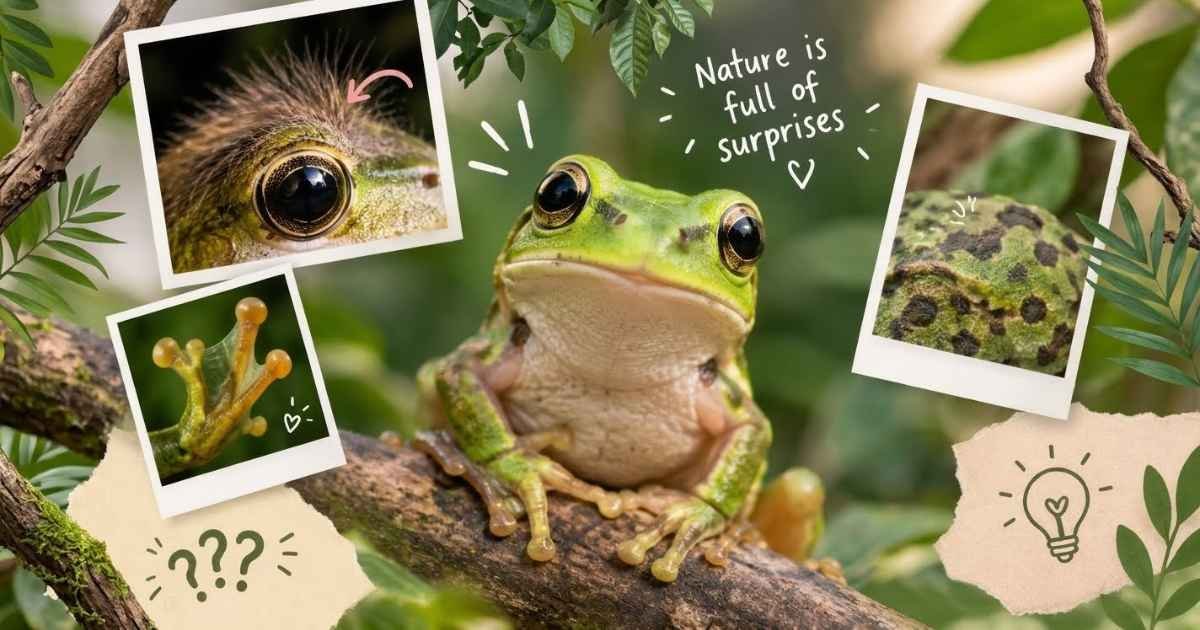
Do Frogs Have Hair? This question may surprise you when you see a frog that looks fuzzy or furry. Most frogs don’t have hair like mammals because their bodies have specialized amphibian skin. Their moist skin supports breathing, water absorption, and protection. However, some unusual frogs develop hair-like structures that make their appearance fascinating. Understanding Do Frogs Have Hair? helps you learn more about frog anatomy and unique frog adaptations.
If you’ve ever wondered why frogs look hairy, the answer lies in their remarkable biology. The hairy frog, scientifically known as Trichobatrachus robustus, is a famous example of this unusual appearance. Although breeding males develop hair-like skin projections, these structures aren’t true hair or fur. Do Frogs Have Hair? remains an interesting question because amphibians have evolved different ways to survive without mammalian body coverings.
Do Frogs Have Hair or Fur?
Have you ever seen a frog that looks fuzzy and wondered whether it has hair? The answer is no. Do frogs have hair? Not in the same way humans, dogs, or cats do. Frogs are amphibians, and their bodies have specialized skin rather than the hair-covered outer layer found in most mammals.
So, do frogs have fur or hair? Neither is a normal part of a frog’s anatomy. However, a few unusual frog species develop hair-like structures that make them look surprisingly furry.
These structures serve different purposes from mammalian hair. They may help certain frogs during breeding or provide other biological advantages.
Here are the key facts to remember:
- Frogs don’t have true hair: Their skin lacks the hair follicles that produce mammalian hair.
- Most frogs have moist skin: A thin layer of mucus helps keep their skin hydrated.
- Some frogs look hairy: Certain species develop unusual skin projections that resemble hair.
- Frog skin supports survival: It helps with moisture balance, oxygen absorption, and protection.
- Their skin can be colorful: Green, brown, yellow, red, and other colors help frogs blend in or warn predators.
Understanding why frogs look different from furry animals reveals some fascinating details about amphibian anatomy.
What Covers a Frog’s Skin?
A frog’s body covering is made of specialized skin, not fur, feathers, or hair. Unlike mammals, frogs rely on their skin for several essential functions beyond simply covering their bodies.
When you examine frog skin texture, you’ll notice that it can appear smooth, bumpy, rough, or slightly warty. These differences depend on the species, its habitat, and its biological adaptations.
Frog skin contains several important structures:
- Epidermis: The outer layer protects the frog’s body from environmental damage.
- Dermis: The deeper layer contains blood vessels, nerves, pigment cells, and skin glands.
- Mucus glands: These glands release mucus that helps maintain moisture and supports normal skin function.
- Granular glands: These glands can produce defensive secretions that discourage predators.
- Blood vessels: A rich network near the skin’s surface helps frogs exchange gases with their surroundings.
Unlike the relatively dry outer skin of many mammals, amphibian skin is generally thin and permeable. That allows water and certain gases to pass through it.
Do Frogs Have Hair? So, what covers a frog’s body? Specialized amphibian skin does the job. It protects internal tissues while supporting breathing, moisture balance, and other processes necessary for survival.
7 Surprising Facts About Frog Hair

The question Do Frogs Have Hair? becomes more interesting when you look at the unusual features of different frog species. Although frogs lack true hair, their skin has remarkable adaptations that help them breathe, stay hydrated, and survive in challenging environments.
Let’s look at seven surprising facts that explain the science behind frog hair and skin.
Frogs Do Not Have True Hair
Frogs don’t grow hair like mammals because their skin doesn’t contain the hair follicles that produce strands of hair. Their external anatomy evolved to meet the needs of amphibian life.
Mammals use hair for insulation, protection, and sensory functions. Frogs rely on other biological adaptations instead.
Here are the main differences:
- Frogs have specialized skin rather than a coat of hair.
- Mammals typically grow hair from follicles embedded in their skin.
- Frogs regulate moisture through their skin and surrounding environment.
- Many mammals depend on fur for insulation, while frogs generally rely on behavioral and environmental strategies to manage temperature.
If you’re asking, Do Frogs Have Hair?, remember that their unusual appearance doesn’t mean they possess mammalian hair.
Frog Skin Helps Them Absorb Water
One of the most fascinating frog skin characteristics is its ability to absorb water directly from the environment. Many frogs take in water through a specialized area on their underside, often called the pelvic patch.
This adaptation helps frogs maintain the hydration they need without drinking water in the same way humans do.
Do Frogs Have Hair? Frog skin is permeable, which means water and certain dissolved substances can pass through it. However, this feature also makes frogs sensitive to pollution and harmful chemicals.
Why this matters:
- Frogs can absorb moisture from wet ground and damp surfaces.
- Their skin helps maintain the body’s water balance.
- Dry conditions can increase the risk of dehydration.
- Contaminated water and chemicals may pass through their skin and harm them.
This is another reason the answer to Do Frogs Have Hair? matters: frogs depend on specialized skin rather than a furry covering.
Some Frogs Have Hair-Like Structures
Although frogs don’t grow true hair, a few species develop structures that resemble it. These unusual features can make certain frogs look fuzzy or shaggy.
The hairy frog, scientifically known as Trichobatrachus robustus, is the best-known example. During the breeding season, males develop thin, hair-like projections along parts of their bodies and hind legs.
These projections aren’t made of keratin like mammalian hair. Instead, they are specialized extensions of the skin.
Scientists associate these structures with increased skin surface area, which may support oxygen absorption while the male remains in water. Their exact contribution to breathing remains an area of scientific interest.
When people ask, Do Frogs Have Hair?, this unusual frog explains why the answer can look confusing at first glance.
Hairy Frogs Develop Unique Skin Projections
The hairy frog has a remarkable feature that sets it apart from most amphibians. Breeding males develop slender, branching skin projections that resemble strands of hair.
These structures are temporary adaptations associated with reproduction. They appear during the breeding season and are not permanent hair like the fur found on mammals.
Do Frogs Have Hair? Scientists believe the projections help increase the surface area available for gas exchange in water. This may be particularly useful when males guard eggs in aquatic environments.
Important details about these projections include:
- They consist of specialized skin tissue rather than true hair.
- They appear most noticeably in breeding males.
- They occur on particular areas of the body.
- They differ from the hair follicles found in mammals.
So, Do Frogs Have Hair? The hairy frog shows that nature can create hair-like appearances without producing actual hair.
Frog Skin Helps Protect Against Predators
Frog skin does more than cover the body. Depending on the species, it may help deter predators through chemical secretions, camouflage, or warning colors.
Many frogs have granular skin glands that release defensive substances. Some species produce irritating or toxic secretions, while others rely mainly on blending into their surroundings.
Their skin colors also play an important role. Green frogs may disappear among leaves, while brown frogs can blend into soil, rocks, and fallen vegetation.
Frog skin protection works in several ways:
- Camouflage: Colors and patterns make frogs harder to spot.
- Chemical defense: Certain skin secretions discourage predators.
- Warning colors: Bright markings can signal danger in some species.
- Moisture control: Mucus helps prevent the skin from drying too quickly.
These adaptations show why frogs don’t need fur for protection. Their skin already performs several essential jobs.
Frogs Shed Their Skin Regularly
Here’s another surprising fact: frogs regularly shed their outer skin as part of their normal growth and maintenance.
This process is called skin shedding, or ecdysis. Unlike snakes, which often shed their skin in larger pieces, many frogs remove their old skin in a more delicate process.
Do Frogs Have Hair? A frog may pull the loose skin toward its mouth and swallow it. This behavior helps recycle some of the material instead of leaving it behind.
During shedding, you might notice a frog making repeated movements with its legs or mouth. These actions help loosen and remove the old layer.
A few useful facts about frog skin shedding:
- Shedding helps replace the outer skin layer.
- The process varies among frog species.
- Frogs often consume the shed material.
- Healthy skin renewal supports normal skin function.
If you’re wondering, Do Frogs Have Hair?, remember that frogs renew their skin rather than growing and shedding a coat of hair.
Moist Skin Helps Frogs Survive
Moist skin is one of the most important features of frog anatomy. Many frogs need a damp surface to maintain normal gas exchange and prevent excessive water loss.
Frogs can exchange oxygen and carbon dioxide through their skin, a process known as cutaneous respiration. Their lungs also contribute to breathing in many species, while some frogs rely heavily on skin-based gas exchange.
Mucus glands help keep the skin moist. However, frogs still need suitable environmental conditions because mucus alone cannot prevent dehydration in every situation.
Here’s why moisture matters:
- It supports oxygen absorption through the skin.
- It helps maintain water balance.
- It allows the skin to function as an effective gas-exchange surface.
- It supports normal physiological processes.
This explains why Do Frogs Have Hair? is more than a question about appearance. Their skin is a specialized survival system, not simply an outer covering.
Frog Skin Comes in Different Colors
Frogs display an impressive range of skin colors, including green, brown, gray, yellow, orange, and red. Some species also feature bold spots, stripes, or contrasting patterns.
These colors often help frogs survive in specific habitats. A green tree frog can blend into foliage, while a brown ground-dwelling frog may disappear against dry leaves or soil.
Other species use bright colors to warn predators that they may be toxic or unpleasant to eat. Some frogs can also change their appearance slightly in response to temperature, light, or other environmental conditions.
Common frog skin colors and their possible functions include:
| Skin color or pattern | Possible advantage |
| Green | Blends into leaves and vegetation |
| Brown | Provides camouflage on soil and forest floors |
| Gray | Helps some frogs blend into rocks or tree bark |
| Yellow or orange | May serve as a warning signal |
| Bright contrasting patterns | Can warn predators in certain species |
| Spotted or striped | Breaks up the body’s outline |
Not every color serves the same purpose. Habitat, species, and behavior all influence frog coloration.
More info: 10 Effective Easy Natural Hair Styles for Busy Mornings
Why Do Frogs Look Hairy Sometimes?
Some frogs look hairy because their skin has folds, ridges, projections, or small bumps. These features can create the appearance of fur, especially when viewed from a distance.
The hairy frog is a famous example, but other frogs can also appear rough or shaggy because of their natural skin texture.
Several factors explain why frogs may look furry:
- Skin projections: Specialized extensions can resemble strands of hair.
- Warty surfaces: Raised bumps create a rough or uneven appearance.
- Skin folds: Wrinkles and ridges may look like clumps of fur.
- Lighting and shadows: Dark areas between skin folds can make the body appear fuzzy.
- Natural camouflage: Some frogs have textured skin that resembles moss, bark, or leaves.
When people ask, Do Frogs Have Hair?, they may be thinking of these unusual appearances rather than true mammalian hair.
A frog’s skin texture often reflects its habitat and lifestyle. Tree-dwelling frogs may have features that help them cling to surfaces, while other species use rough skin and earthy colors to blend into the ground.
Do Frogs Have Hair? Appearance alone, therefore, doesn’t tell you whether an animal has hair. You need to look at its anatomy.
What Is the Hairy Frog and Why Is It Unique?
The hairy frog (Trichobatrachus robustus) is an unusual African frog known for the hair-like projections that develop on breeding males. It lives in parts of Central Africa, where it inhabits forested environments and streams.
Despite its nickname, this species doesn’t have actual hair. Its unusual appearance comes from specialized skin structures that appear during a particular stage of its reproductive cycle.
So, Do Frogs Have Hair? The hairy frog provides a fascinating example of how an animal can look furry without possessing true hair.
Here’s what makes this species special:
- Hair-like projections: Breeding males develop thin extensions of skin around parts of their bodies.
- Reproductive behavior: Males guard eggs in aquatic environments, making their breeding behavior particularly interesting.
- Possible breathing advantage: The projections increase skin surface area and may help support oxygen absorption in water.
- Powerful hind legs: Like many frogs, this species has strong legs suited to movement.
- Distinctive anatomy: Its unusual skin structures make it one of the most recognizable examples of hair-like features in amphibians.
Why Do Male Hairy Frogs Develop These Structures?
Scientists associate the projections with the breeding season. Researchers believe the extra surface area may help males exchange gases through their skin while they remain in water to guard their eggs.
However, these structures aren’t equivalent to hair or fur. They lack the mammalian hair follicles and keratin-based fibers that produce a typical coat.
Do Frogs Have Hair? The hairy frog demonstrates how evolution can produce unusual adaptations for specific environmental and reproductive demands.
How Is Frog Skin Different From Mammal Skin?

Frog skin and mammal skin share some basic functions, but their structure and everyday roles differ considerably.
Mammals generally have skin equipped with hair follicles, while frogs have specialized, permeable skin that supports gas exchange and water balance.
If you’re asking, Do Frogs Have Hair?, comparing these two types of skin makes the answer easier to understand.
| Feature | Frog skin | Mammal skin |
| Hair follicles | No true hair-producing follicles | Usually present |
| Body covering | Moist, specialized skin | Skin that may have hair or fur |
| Moisture | Often depends on environmental moisture | Varies by species and skin adaptations |
| Breathing | Many frogs exchange gases through their skin | Most mammals rely on lungs |
| Protection | Mucus, skin secretions, and camouflage | Skin barrier, hair, and other defenses |
| Temperature regulation | Primarily relies on environmental conditions and behavior | Varies; many mammals use internal heat regulation |
| Skin shedding | Regularly replaces the outer skin layer | Continuously renews skin cells |
Why Does This Difference Matter?
Mammals and frogs evolved different solutions to similar survival challenges. Fur helps many mammals retain heat, while specialized frog skin allows gas exchange and supports hydration.
For example, a furry dog can remain comfortable in conditions that would quickly dry out some frogs. A frog, meanwhile, can absorb water through its skin, an ability that ordinary mammalian skin doesn’t provide in the same way.
Do Frogs Have Hair? These differences reflect the needs of two distinct animal groups.
Do Frogs Have Fur, Feathers, or Scales?
Frogs don’t naturally have fur, feathers, or the hard scales associated with reptiles. Their main body covering is specialized amphibian skin.
Although Do Frogs Have Hair? sounds like a simple question, it helps distinguish frogs from other animals with very different body coverings.
Here’s how these coverings compare:
- Hair and fur: Mammals grow hair from follicles. Fur is a dense covering of hair found in many species.
- Feathers: Birds grow feathers that support flight, insulation, display, or other functions.
- Scales: Reptiles generally have scales that help protect their bodies and reduce water loss.
- Amphibian skin: Frogs usually have thin, permeable skin that supports moisture balance and gas exchange.
Do Frogs Have Scales Like Reptiles?
No. Most frogs don’t have the external scales found on snakes and lizards. Their skin may feel smooth, rough, or bumpy, but these textures aren’t the same as reptilian scales.
Do Any Amphibians Have Hair?
No known amphibian species naturally grows true mammalian hair. Some amphibians develop unusual skin structures that resemble hair, but these are anatomically different from hair fibers.
The hairy frog remains a well-known example of this distinction.
Can Frogs Grow Hair?
Frogs don’t grow hair in the mammalian sense. However, certain species develop temporary or specialized hair-like projections as part of their biological adaptations.
Therefore, Do Frogs Have Hair? The scientific answer remains no, even when a frog’s appearance suggests otherwise.
How Does Frog Skin Help Them Survive?

Frog skin is one of their most important survival tools. It supports breathing, water absorption, protection, and communication through colors and patterns.
Without these specialized features, many frogs would struggle to survive in their natural habitats.
Essential Functions of Frog Skin
Gas exchange: Many frogs absorb oxygen through their moist skin and release carbon dioxide. This process complements lung breathing in species that have functional lungs.
Water absorption: Frogs can absorb water directly from damp surfaces. This helps them maintain hydration without relying entirely on drinking.
Chemical protection: Certain skin glands release substances that discourage predators. The strength and type of these defenses vary among species.
Camouflage: Natural skin colors help frogs blend into leaves, mud, rocks, and tree bark.
Sensory functions: Nerve endings in the skin help frogs detect touch and other environmental changes.
Skin renewal: Regular shedding replaces the outer layer and supports healthy skin function.
Why Do Frogs Need Moist Skin?
Moisture is essential because frog skin must remain suitable for gas exchange and water balance. When conditions become too dry, some frogs seek shelter beneath leaves, burrow into soil, or become less active.
Different species have different moisture needs. Aquatic frogs generally spend more time in water, while some terrestrial frogs use behavioral adaptations to limit water loss.
Understanding these features helps explain why Do Frogs Have Hair? is really a question about how amphibians evolved to survive.
Unlike mammals, frogs don’t depend on a coat of fur to meet their everyday needs. Their skin performs several jobs at once.
How Do Frogs Protect Their Skin?
Frogs use several strategies to keep their skin functioning properly:
- They seek damp hiding places during dry weather.
- Many species produce mucus that helps maintain skin moisture.
- Some avoid intense sunlight to reduce water loss.
- Certain frogs use defensive skin secretions against predators.
- Their natural colors and patterns help them avoid detection.
These behaviors support amphibian survival, particularly in environments where temperature and moisture change throughout the day.
Frequently Asked Questions
Do Frogs Have Hair or Fur Like Mammals?
No, Do Frogs Have Hair? Frogs lack true hair and fur, relying on specialized skin for survival.
Why Do Some Frogs Look Furry?
Some frogs develop hair-like skin projections, making Do Frogs Have Hair? an interesting question about amphibian anatomy.
What Is the Hairy Frog Called?
Do Frogs Have Hair? The hairy frog is Trichobatrachus robustus, whose males develop unusual skin projections during breeding season.
Can Frogs Absorb Water Through Their Skin?
Yes, Do Frogs Have Hair? relates to their specialized skin, which absorbs water and supports moisture balance.
Why Do Frogs Shed Their Skin?
Do Frogs Have Hair? Frogs shed their outer skin regularly to renew its surface, supporting healthy skin function and normal amphibian survival.
Conclusion
So, Do Frogs Have Hair? No, frogs don’t have true hair, fur, or feathers. Their bodies rely on specialized amphibian skin that helps them absorb water, exchange gases, and defend themselves against environmental threats.
The hairy frog makes this topic especially interesting because breeding males develop unusual skin projections that look like hair. However, these structures aren’t mammalian hair and serve different biological purposes.
When you understand frog anatomy, their unusual appearances become easier to explain. From smooth tree frogs to rough-skinned species, each frog has features suited to its environment.
The next time you see a frog that looks fuzzy, remember that its appearance doesn’t necessarily mean it has hair. Do Frogs Have Hair? Not in the traditional sense. Their remarkable skin provides the adaptations they need to survive without a furry covering.

HairVist is a helpful destination for hair care tips, hairstyle ideas, and beauty inspiration, managed by Ava Reynolds, an SEO content writer with 2 years of experience, focused on creating simple, useful, and engaging content that helps readers learn more about hair care and styling.
1 thought on “Do Frogs Have Hair? 7 Surprising Facts You Should Know”