
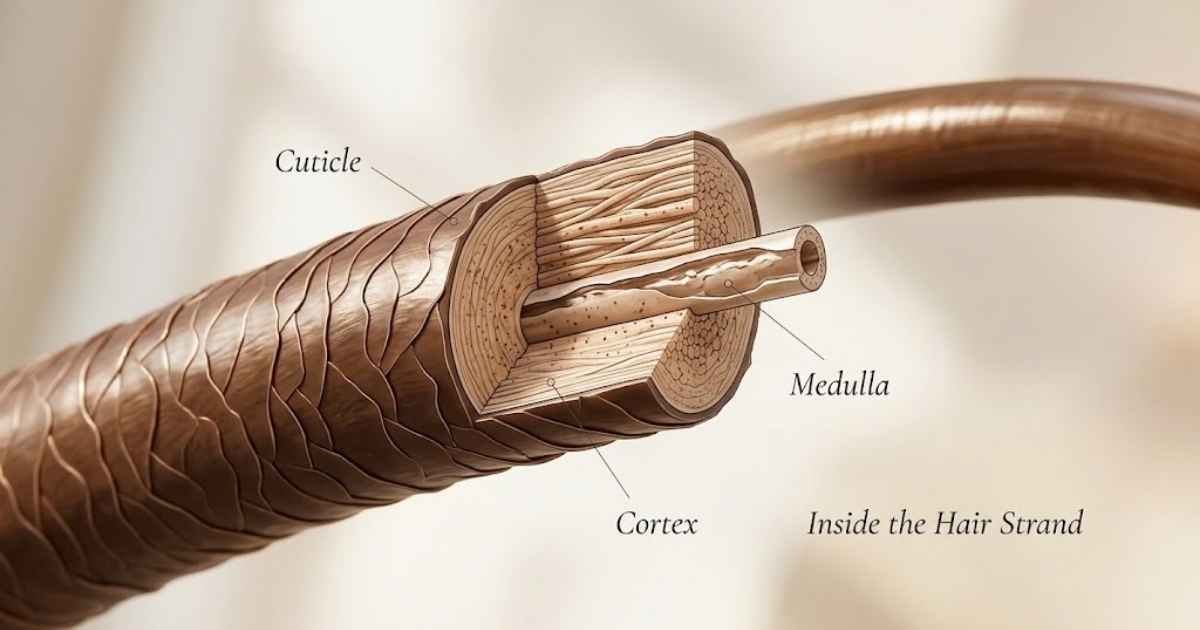
Your hair looks simple, yet each strand has a surprisingly detailed internal design. A Hair Shaft Diagram makes that structure easier to understand at a glance. It shows the main hair shaft layers, including the hair cuticle, hair cortex, and hair medulla. Learning this hair shaft anatomy can help you understand why strands feel smooth, strong, dry, or fragile. A clear hair anatomy diagram also shows how the hair strand structure supports everyday hair health.
Whether you’re learning about human hair anatomy or improving your routine, a Hair Shaft Structure gives you a useful starting point. You’ll see how the hair cuticle protects deeper layers while the hair cortex provides strength and flexibility. The hair medulla forms the central core in many strands. Understanding these parts of the hair shaft also makes hair shaft damage, breakage, porosity, and chemical stress easier to understand. With this Hair Shaft Diagram, hair anatomy becomes much simpler.
Hair Shaft Anatomy: What the Diagram Shows
A Hair Shaft Diagram gives you a simple visual way to understand how a strand of hair is built. Instead of viewing hair as one solid fiber, the diagram shows its different layers and explains what each part does. This makes hair anatomy explained simply much easier to understand.
When you study a Hair Shaft Structure , you’ll usually see the hair shaft divided into three main layers: the cuticle, cortex, and medulla. These layers work together to create the appearance, strength, texture, and flexibility of each strand.
A typical hair anatomy diagram may also show the shaft above the scalp and the follicle beneath it. These structures connect to hair growth, but they aren’t the same thing.
| Part | Where It Is | Main Role |
| Cuticle | Outer surface | Protects the inner hair |
| Cortex | Middle layer | Provides strength, shape, and color |
| Medulla | Center | Forms the innermost core |
| Hair follicle | Beneath the scalp | Produces and anchors hair |
A clear Hair Shaft Structure can therefore help you understand the structure of a human hair strand at a glance.
Understanding the Three Main Layers of the Hair Shaft
The easiest way to understand hair shaft structure is to picture it like a tiny rope with multiple layers. Each layer has its own job, yet none works completely alone.
The Hair Shaft Structure typically highlights the cuticle, cortex, and medulla. Together, these layers form the basic hair fiber structure.
The three hair shaft layers include:
- Cuticle: The outer layer that shields the inner fiber.
- Cortex: The thick middle layer responsible for much of the strand’s strength.
- Medulla: The innermost layer located near the center of the hair.
Not every strand has a clearly defined medulla. Fine hair may have a very narrow or discontinuous medulla, while thicker strands often show it more clearly.
This three-part design explains why a Hair Shaft Diagram looks different from a simple picture of a single hair strand. It reveals the hidden architecture underneath the surface.
Hair Cuticle: The Protective Outer Layer
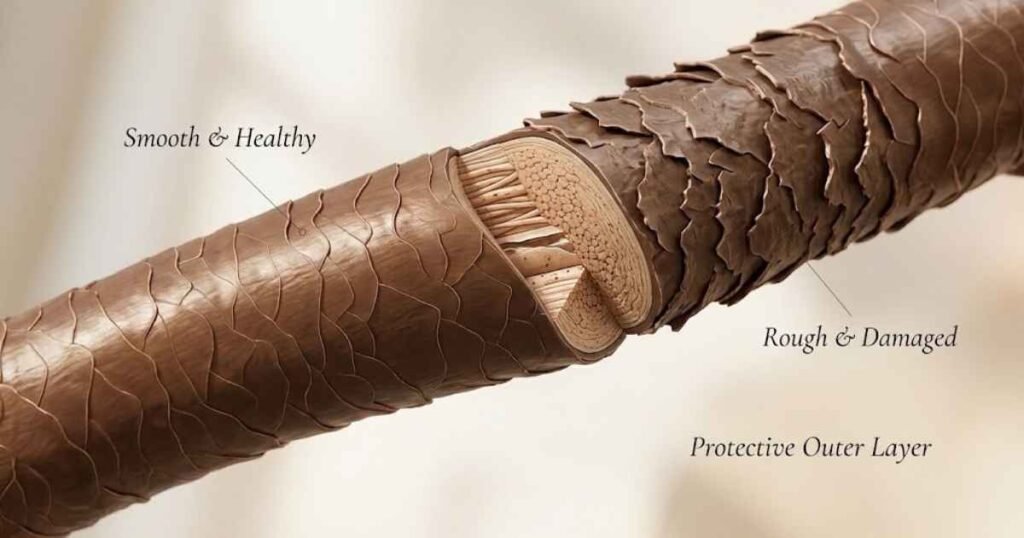
Look closely at a Hair Shaft Structure, and the cuticle usually appears as the strand’s outermost covering. Think of it like overlapping roof shingles protecting a house from rain.
The hair cuticle consists of tiny overlapping cuticle scales. These scales help protect the cortex from everyday environmental and styling stress.
The function of the hair cuticle includes:
- Shielding the inner hair fiber
- Reducing moisture loss
- Supporting smoother hair texture
- Helping control hair porosity
- Protecting against friction
- Contributing to natural shine
The hair cuticle layer can become rough when you repeatedly expose your hair to excessive heat, chemicals, or mechanical stress. Once these scales become lifted or worn, the cortex becomes more vulnerable.
That’s why the Hair Shaft Diagram places the cuticle around the outside. It acts as the first line of defense.
A healthy cuticle generally lies more smoothly along the strand. A damaged cuticle may feel rough, look dull, tangle easily, and contribute to split ends.
Hair Cortex: The Strong Inner Layer
Beneath the cuticle sits the hair cortex, which makes up most of the hair’s mass. In many strands, it’s the powerhouse of the entire fiber.
A Hair Shaft Structure often shows the cortex as the thick middle section surrounding the medulla. Its structure contains keratin-rich fibers and other components that contribute heavily to hair strength and elasticity.
The cortex helps determine:
- Hair strength
- Hair elasticity
- Hair texture
- Hair shape
- Hair color
- Resistance to stretching
- Overall fiber durability
The cortex also contains melanin, the pigment responsible for much of your natural hair color.
When chemical treatments penetrate deeply into the hair, they can alter the cortex. Bleaching, relaxing, permanent coloring, and repeated processing may affect its protein structure.
A detailed Hair Shaft Structure makes this relationship easier to visualize because you can see how the protective cuticle surrounds the cortex.
Hair Medulla: The Central Core of Hair
At the center of many thicker strands sits the hair medulla. In a Hair Shaft Structure, this section appears as the innermost layer running through the center of the fiber.
The medulla doesn’t always appear as one continuous tube. Some hair strands have a broken medulla, while very fine hair may lack a visible medulla altogether.
The function of the hair medulla is less clearly defined than the other layers.
However, the medulla can:
- Form the central core of thicker hair fibers
- Contain loosely arranged cells
- Contribute to the overall internal structure
- Appear differently depending on hair thickness
Because the medulla varies considerably between strands, a Hair Shaft Diagram shouldn’t be interpreted as showing identical anatomy for every person.
The key idea is simple: the medulla at the center of hair sits inside the cortex, while the cuticle surrounds everything.
How Each Hair Shaft Layer Works Together
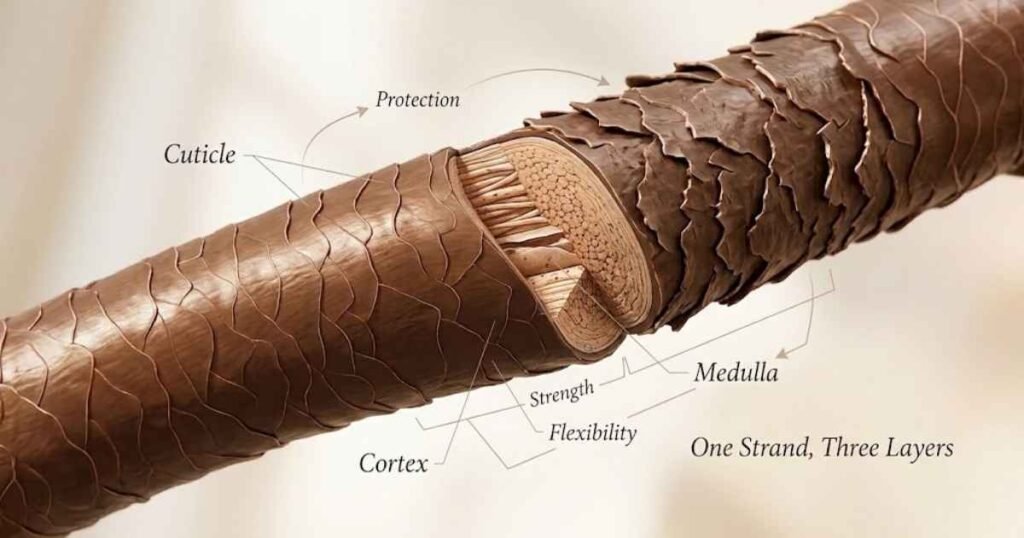
A Hair Shaft Structure becomes even more useful when you stop looking at each layer separately. The cuticle, cortex, and medulla form one connected hair fiber.
Imagine a three-layered building. The outer walls provide protection, the central structure provides much of the strength, and the interior forms the core. Hair works in a somewhat similar way.
| Hair Layer | Main Function | What Damage May Affect |
| Cuticle | Protection | Smoothness, shine, porosity |
| Cortex | Strength and flexibility | Elasticity, breakage, shape |
| Medulla | Central structure | Internal fiber characteristics |
The hair cuticle protects the cortex, while the cortex provides much of the strand’s strength. Together, these layers influence how hair responds to brushing, styling, moisture, heat, and chemical services.
For example, frequent flat-iron use can gradually weaken the outer surface and affect deeper fiber components. Chemical processing can also change the internal protein structure.
Understanding this teamwork makes a Hair Shaft Diagram more than a labeled picture. It becomes a practical guide to understanding everyday hair behavior.
Hair Shaft Structure and Its Role in Hair Health
Your hair shaft structure directly influences how a strand looks, feels, stretches, and responds to hair care. Once you understand the Hair Shaft Diagram, many common hair problems become easier to recognize.
Healthy hair typically has a relatively intact cuticle and a strong cortex. Excessive styling can gradually change that structure, leading to a damaged hair shaft.
Common causes of hair shaft damage include:
- Frequent high-heat styling
- Repeated bleaching
- Aggressive chemical treatments
- Rough brushing or detangling
- Tight hairstyles that create friction
- Excessive exposure to environmental stress
- Repeated washing with unsuitable products
Signs of a damaged hair shaft
- Rough or brittle texture
- Increased tangling
- Split ends
- Excessive breakage
- Reduced shine
- Uneven texture
- Poor elasticity
- Greater sensitivity to styling
A Hair Shaft Diagram can help connect these visible symptoms with what’s happening inside the strand. For instance, roughness may relate to changes in the cuticle, while severe weakness can involve damage deeper within the cortex.
Healthy versus damaged hair structure
| Healthy Hair | Damaged Hair |
| Smoother cuticle surface | Raised or worn cuticle |
| Better elasticity | Reduced flexibility |
| Stronger fiber | Increased breakage |
| More even texture | Rough or brittle texture |
| Better protection | Greater vulnerability |
Ultimately, learning from a Hair Shaft Diagram gives you a clearer picture of human hair anatomy and everyday hair health. The cuticle protects the fiber, the cortex supplies much of its strength, and the medulla forms the central core.
Once you understand these parts of the hair shaft, choosing gentler styling habits becomes much easier. A little knowledge of microscopic hair structure can make your entire hair-care routine more intentional.
MUST READ: Vinh Hair Salon: 10 Essential Things to Know Before Booking
What a Healthy Hair Shaft Looks Like
A healthy Hair Shaft Diagram usually shows three organized layers: the cuticle, cortex, and medulla. Although you can’t see these structures with your eyes, their condition affects how your hair looks and behaves every day.
Healthy hair generally feels smooth rather than rough. It also bends without snapping easily and maintains a reasonable level of elasticity.
Key signs of healthy hair structure
- Smooth cuticle scales: The outer surface lies relatively flat and feels softer.
- Strong cortex: The middle layer supports hair strength, flexibility, and shape.
- Balanced moisture: The strand doesn’t feel excessively dry or overly fragile.
- Good elasticity: Healthy hair can stretch slightly and return toward its original shape.
- Even texture: The hair strand feels fairly consistent from root to tip.
- Natural shine: A smoother cuticle can reflect light more evenly.
- Fewer split ends: Stronger fibers generally resist everyday breakage better.
Think of your hair like a flexible thread. When its outer covering stays intact, the inner fiber gets better protection.
A Hair Shaft Diagram helps illustrate why surface condition matters. The hair cuticle protects the cortex, so damage to the outer layer can leave deeper structures more exposed.
Common Hair Shaft Damage and Its Causes
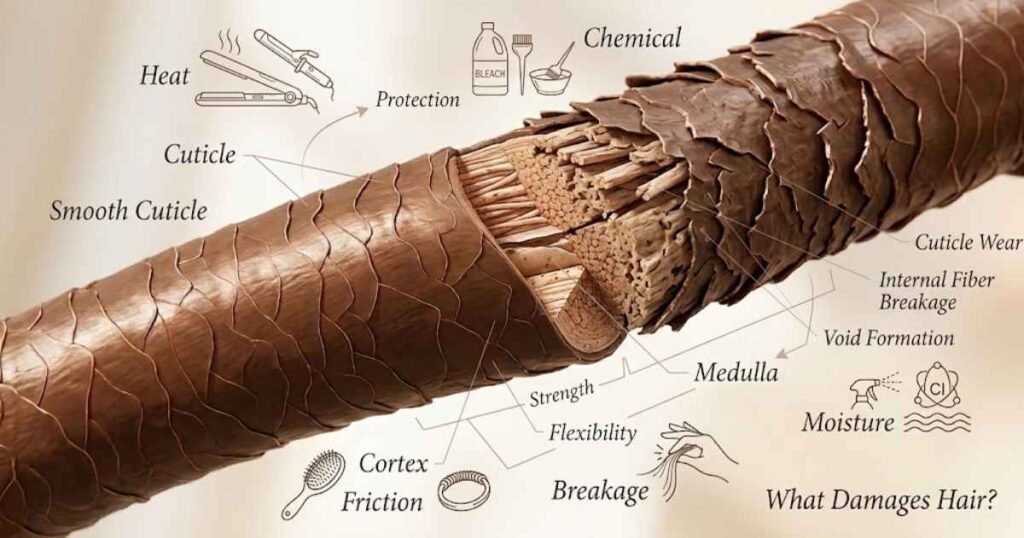
Hair doesn’t become damaged overnight in most cases. Instead, repeated stress gradually changes the hair shaft structure. Brushing, styling, coloring, and environmental exposure can all contribute over time.
A damaged hair shaft may lose some of its smoothness and strength. The more severe the damage becomes, the easier the strand may break.
Common types of hair shaft damage
| Damage Type | Common Cause | Possible Sign |
| Cuticle wear | Friction and rough handling | Rough texture |
| Heat damage | Flat irons and curling tools | Dryness and brittleness |
| Chemical damage | Bleaching and relaxing | Weakness and breakage |
| Mechanical damage | Aggressive brushing | Snapping and split ends |
| Moisture imbalance | Excessive processing | Stiff or overly dry strands |
What can contribute to hair shaft damage?
- Frequent high-temperature styling
- Repeated bleaching or coloring
- Tight ponytails and extensions
- Rough towel drying
- Aggressive detangling
- Excessive brushing
- Chlorinated or saltwater exposure
- Repeated chemical processing
The parts of the hair shaft don’t all respond to stress in exactly the same way. Surface wear may affect the cuticle first, while deeper chemical changes can affect the cortex.
That distinction matters when you’re trying to improve overall hair health.
How Heat and Chemicals Affect the Hair Shaft
Heat and chemicals can change hair shaft anatomy in ways that aren’t immediately obvious. A single styling session may not create dramatic damage, yet repeated exposure can gradually weaken the fiber.
Heat and hair structure
High temperatures can affect the hair’s moisture balance and protein structure. Frequent use of flat irons, curling irons, and hot blow-drying may leave strands increasingly dry and fragile.
The effects of heat on hair structure can include:
- Rougher cuticle scales
- Increased dryness
- Reduced elasticity
- Greater brittleness
- More breakage
- Increased split ends
Heat doesn’t affect every strand equally. Fine, chemically treated hair often needs more careful temperature control than thick, untreated hair.
Chemical treatments
Bleach, permanent color, relaxers, and other chemical services can alter the structure of the hair fiber. Strong processing may penetrate beyond the cuticle and affect the hair cortex layer.
The effects of chemicals on the hair shaft may include:
- Weakened protein structure
- Increased porosity
- Reduced elasticity
- Rougher texture
- Greater susceptibility to breakage
A useful way to picture this is to imagine the cuticle as a protective jacket. When repeated processing wears down that jacket, the inner fiber has less protection.
Understanding the Hair Shaft Diagram can therefore help you see why heat protection and careful chemical processing matter.
Hair Shaft Diagram for Different Hair Types
A Hair Shaft Diagram can represent the basic anatomy of straight, wavy, curly, and coily hair. However, the visible shape of a strand can vary considerably between hair types.
The fundamental hair shaft layers remain the cuticle, cortex, and medulla. What changes is the shape, thickness, curvature, and behavior of the fiber.
| Hair Type | Typical Shaft Characteristics | Common Consideration |
| Straight | Often appears relatively uniform | Oil can travel down the strand more easily |
| Wavy | Curved with gentle bends | May experience mixed texture |
| Curly | More pronounced curves | Can experience dryness along lengths |
| Coily | Tighter curves and bends | Requires gentle handling to reduce breakage |
Your hair type doesn’t mean every individual strand has identical anatomy. Thickness and density can vary across the same head.
For this reason, a hair anatomy diagram provides a general structural model rather than a perfect representation of every person.
The hair strand structure also affects how products, moisture, friction, and styling techniques interact with the fiber. That’s why a hair-care routine should consider your actual strand characteristics instead of relying only on your curl pattern.
Simple Ways to Protect and Strengthen the Hair Shaft
Once you understand how the hair shaft is structured, protecting it becomes much more straightforward. You don’t need an elaborate routine. Consistent, gentle habits can make a meaningful difference.
Practical ways to maintain healthy hair structure
- Use heat protectant: Apply it before using hot styling tools.
- Lower styling temperatures: Use the lowest effective heat setting.
- Detangle gently: Start at the ends and gradually move upward.
- Avoid excessive brushing: Handle wet or fragile hair with extra care.
- Condition regularly: Keep the fiber manageable and reduce friction.
- Space out chemical services: Give processed hair time between treatments.
- Trim damaged ends: Regular trims can remove visibly split sections.
- Protect hair while sleeping: A satin or silk surface can reduce friction.
- Limit tight hairstyles: Reduce repeated pulling and mechanical stress.
- Handle wet hair carefully: Wet strands can stretch more easily during manipulation.
A simple hair shaft protection routine
| Step | What to Do | Why It Helps |
| Wash | Cleanse according to your scalp needs | Removes buildup |
| Condition | Focus on the lengths and ends | Improves manageability |
| Detangle | Work gently from ends upward | Limits mechanical stress |
| Style | Use heat protection | Reduces heat-related stress |
| Maintain | Trim visibly damaged ends | Keeps ends neater |
The goal isn’t to keep your hair completely untouched. Hair naturally experiences daily friction and environmental stress. Instead, focus on reducing unnecessary damage.
A clear Hair Shaft Diagram reminds you that every strand has an outer protective layer and deeper structural components. When you protect the hair cuticle, support the hair cortex, and handle your strands gently, you create better conditions for maintaining a strong, healthy hair fiber.
Ultimately, healthy-looking hair starts with healthy habits. Understanding hair strand anatomy simply gives you a better roadmap for those habits.
FAQ’s
What are the main layers inside a human hair strand?
A Hair Shaft Diagram shows the cuticle, cortex, and medulla as the primary structural layers of hair.
What does the outer hair layer do?
The Hair Shaft Diagram shows how the cuticle protects deeper structures from friction, moisture loss, and everyday damage.
Which part gives hair most of its strength?
The Hair Shaft Diagram identifies the cortex as the layer responsible for much of hair’s strength and elasticity.
Where is the central core of hair located?
A Hair Shaft Diagram places the medulla at the center, although fine strands may lack one.
Why does hair become damaged over time?
A Hair Shaft Diagram helps connect heat, chemicals, and friction with changes in the hair’s structure.
Conclusion
Understanding a Hair Shaft Diagram gives you a clearer view of what happens inside every strand. The hair cuticle forms the protective surface, while the hair cortex provides much of the strand’s strength, elasticity, and shape. The hair medulla sits at the center when present. Together, these hair shaft layers create the basic hair fiber structure that influences texture and durability.
Once you understand this hair shaft anatomy, everyday hair care makes more sense. Heat, chemicals, friction, and rough handling can gradually affect the hair shaft structure. A damaged cuticle can expose the cortex to additional stress. Learning the parts of the hair shaft helps you recognize those changes earlier. Keep this Hair Shaft Diagram in mind when choosing styling habits and products. Healthy hair starts with understanding its structure and treating each hair strand with care.

HairVist is a helpful destination for hair care tips, hairstyle ideas, and beauty inspiration, managed by Ava Reynolds, an SEO content writer with 2 years of experience, focused on creating simple, useful, and engaging content that helps readers learn more about hair care and styling.
1 thought on “Hair Shaft Diagram: 7 Essential Parts Explained Simply”