
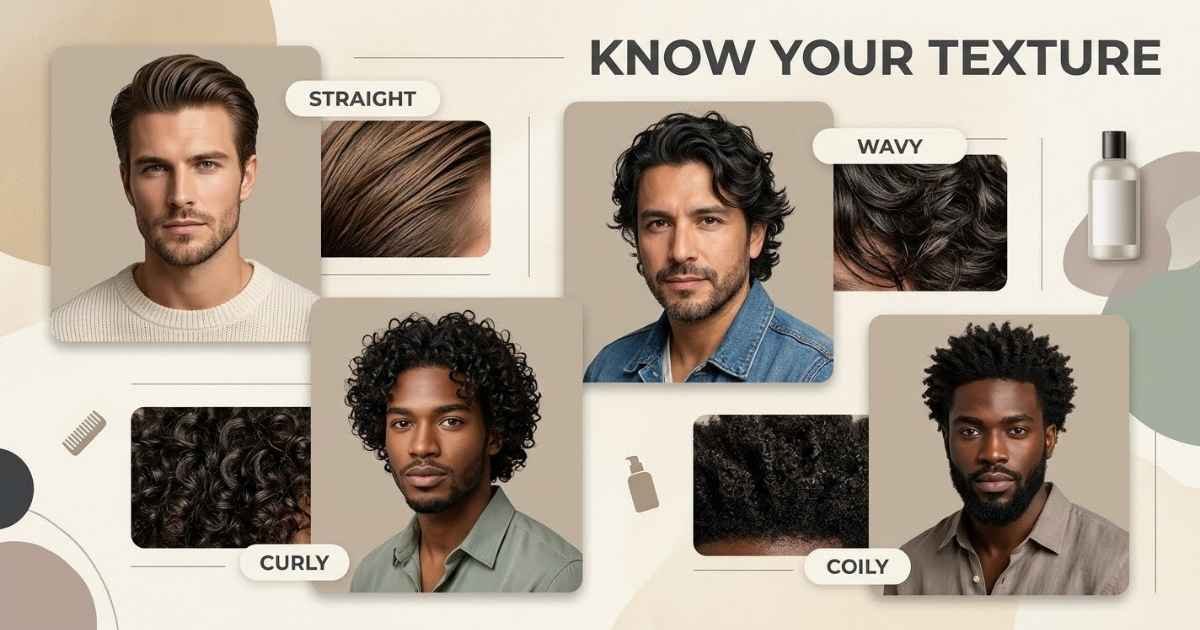
Your hair can look completely different depending on its natural texture, curl pattern, thickness, and daily care routine. Understanding these characteristics makes choosing the right haircut, shampoo, conditioner, and styling products much easier.
A hair type chart men guide helps you identify your natural hair pattern and understand what your hair needs to look its best. Whether your hair falls straight against your scalp, forms relaxed waves, develops springy curls, or grows in tight coils, there’s a practical way to care for it.
This guide covers all four main Hair Type Chart Men, from Type 1A straight hair to Type 4C tightly coiled hair. You’ll also learn how to identify your hair type at home, choose flattering men’s hairstyles, and build a simple routine that fits your lifestyle.
Why Knowing Your Hair Type Matters
Understanding your natural hair makes everyday grooming easier. A hair type chart men guide gives you a useful starting point for choosing products and hairstyles that work with your hair rather than against it.
For example, fine straight hair may need lightweight styling products, while tightly coiled hair often benefits from richer moisturizing formulas. Using the same routine for both can produce disappointing results.
Here are the main reasons to identify your Hair Type Chart Men:
- Choose better haircuts: Your natural pattern helps you select styles that fall naturally and require less effort.
- Buy suitable products: The best men’s hair products depend on your texture, scalp condition, and styling goals.
- Control frizz: Understanding your curl pattern helps you manage flyaways without weighing your hair down.
- Improve moisture retention: Different textures respond differently to conditioners, oils, and leave-in treatments.
- Save grooming time: A suitable routine can make morning styling quicker and more predictable.
- Protect your hair: Knowing your hair’s needs helps you reduce unnecessary heat, harsh brushing, and breakage.
Your Hair Type Chart Men doesn’t determine whether your hair looks good. Every pattern has its own advantages, and the right approach helps you make the most of them.
The Complete Hair Type Chart for Men
The easiest way to understand male Hair Type Chart Men is to begin with the four main categories. This hair type chart men reference uses the widely recognized Type 1 through Type 4 classification system.
Each category describes a general natural pattern, while the letter identifies its subtype.
| Hair type | Subtypes | Natural pattern | Common characteristics |
| Type 1 | 1A, 1B, 1C | Straight | Little to no natural curl |
| Type 2 | 2A, 2B, 2C | Wavy | Loose waves to deep S-shaped waves |
| Type 3 | 3A, 3B, 3C | Curly | Visible loops and springy curls |
| Type 4 | 4A, 4B, 4C | Coily | Tight coils, zigzags, or compact bends |
Here’s a quick breakdown of the men’s Hair Type Chart Men:
- Type 1: Straight hair with little natural bend.
- Type 2: Wavy hair with varying degrees of movement.
- Type 3: Curly hair with noticeable loops or ringlets.
- Type 4: Coily hair with tight bends and compact patterns.
Remember that Hair Type Chart Men classification describes your natural pattern, not your hair’s overall health. Density, strand thickness, porosity, and length also affect how your hair looks and behaves.
For example, two men can both have Type 3A curls, yet one may have fine, low-density hair while the other has thick, dense curls. Their styling needs could be quite different.
Type 1: Straight Hair Types for Men
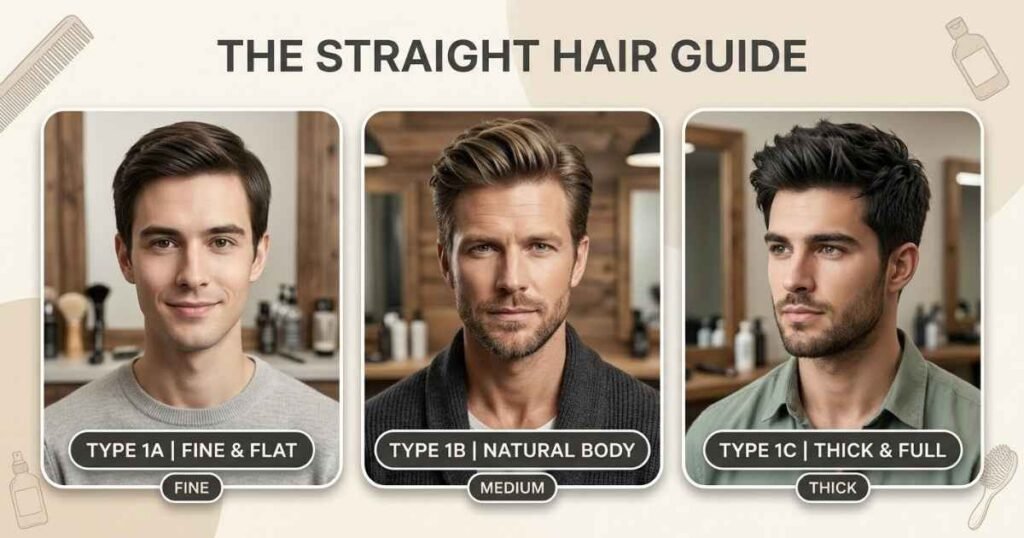
A hair type chart men reference starts with Type 1, the category for naturally straight hair. This Hair Type Chart Men usually grows without a visible wave or curl, although some strands may bend slightly.
Straight hair often reflects light well, giving it a smooth appearance. However, it can also become oily quickly, especially when the scalp produces excess sebum.
Type 1A: Fine Straight Hair
Type 1A hair is typically very straight, soft, and fine. It usually lacks natural volume and can sit close to the scalp.
- Best hairstyles: Textured crop, short fringe, classic crew cut, and layered styles.
- Best products: Lightweight shampoo, volumizing mousse, and matte styling powder.
- Main challenge: Flat roots and products that make hair look greasy.
- Care tip: Use small amounts of styling product to maintain natural movement.
Type 1B: Medium Straight Hair
Type 1B hair has a little more body than Type 1A. It generally appears straight but may hold a slight bend or subtle shape.
- Best hairstyles: Side part, textured quiff, Ivy League, and short back and sides.
- Best products: Lightweight cream, texture spray, and flexible-hold styling products.
- Main challenge: Maintaining volume without making the hair stiff.
- Care tip: Ask your barber for light layering to improve movement.
Type 1C: Thick Straight Hair
Type 1C hair usually feels coarser or heavier and may develop slight bends around the ends. It often holds its shape well but can be harder to control.
- Best hairstyles: Textured crop, undercut, modern pompadour, and layered medium-length cuts.
- Best products: Lightweight smoothing cream, heat protectant, and flexible styling paste.
- Main challenge: Bulky sides, stubborn strands, and unwanted puffiness.
- Care tip: Choose a haircut that removes excess bulk without sacrificing shape.
The right hair type chart men approach helps you distinguish between fine, medium, and coarse straight hair. Keep in mind that strand thickness and density are separate characteristics, even when they affect your hairstyle in similar ways.
Type 2: Wavy Hair Types for Men
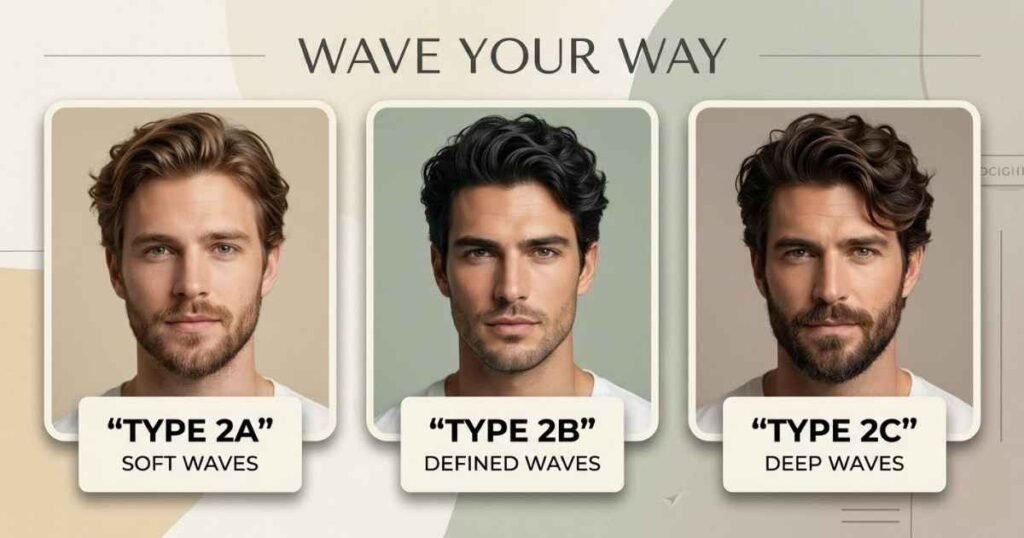
Type 2 hair falls between straight and curly. It forms natural bends or S-shaped waves rather than staying completely straight or developing full ringlets.
A hair type chart men guide can help you recognize how much definition your waves naturally have. Wavy hair can look relaxed and effortless, although humidity may increase frizz.
Type 2A: Loose Waves
Type 2A hair has gentle waves that become more noticeable as the hair grows. The roots may appear relatively straight while the ends develop soft movement.
- Best hairstyles: Messy fringe, medium-length flow, textured crop, and relaxed side part.
- Best products: Sea salt spray, lightweight mousse, and light styling cream.
- Main challenge: Waves falling flat throughout the day.
- Care tip: Scrunch damp hair gently to encourage natural wave definition.
Type 2B: Defined Waves
Type 2B hair develops more noticeable S-shaped waves, often beginning around the middle of the hair shaft. It usually has more natural texture and volume than Type 2A.
- Best hairstyles: Textured quiff, wavy side part, layered fringe, and medium-length curtains.
- Best products: Lightweight curl cream, sea salt spray, and flexible-hold gel.
- Main challenge: Frizz and uneven wave definition.
- Care tip: Avoid excessive brushing when your hair is dry.
Type 2C: Deep Waves
Type 2C hair has stronger, deeper waves that may begin near the roots. Some sections can form loose curls, making this subtype look fuller and more textured.
- Best hairstyles: Layered medium cut, wavy pompadour, textured fringe, and longer swept-back styles.
- Best products: Leave-in conditioner, curl-enhancing cream, and lightweight anti-frizz products.
- Main challenge: Managing bulk and maintaining definition.
- Care tip: Use a wide-tooth comb on damp hair to reduce unnecessary pulling.
When using a hair type chart men reference, remember that wavy hair can behave differently depending on length, climate, and styling habits. In humid parts of the United States, a lightweight anti-frizz product may help keep waves defined without making them greasy.
Type 3: Curly Hair Types for Men

Type 3 hair forms visible curls, loops, or ringlets. These curls create natural volume and movement, but they may also tangle more easily than straight hair.
The hair type chart men classification separates curly hair into three subtypes based on curl size and tightness.
Type 3A: Loose Curls
Type 3A hair usually forms large, loose ringlets with noticeable definition. The curls may stretch when wet and bounce back as the hair dries.
- Best hairstyles: Curly fringe, medium-length layers, tapered sides, and natural curls with a low fade.
- Best products: Lightweight leave-in conditioner and curl cream.
- Main challenge: Frizz and curls losing their shape.
- Care tip: Apply styling products to damp hair and allow the curls to dry gently.
Type 3B: Springy Curls
Type 3B hair features tighter, springier curls than Type 3A. It often creates substantial volume and may shrink noticeably as it dries.
- Best hairstyles: Curly taper, textured crop, rounded medium cut, and layered curly top.
- Best products: Moisturizing conditioner, curl cream, and flexible-hold gel.
- Main challenge: Tangles, dryness, and uneven curl definition.
- Care tip: Detangle gently with conditioner and a wide-tooth comb.
Type 3C: Tight Curls
Type 3C hair contains tight, densely packed curls that can resemble corkscrews. It often has plenty of natural volume and can experience significant shrinkage.
- Best hairstyles: Curly high top, rounded shape, taper fade, and layered medium curls.
- Best products: Leave-in conditioner, richer curl cream, and moisturizing styling gel.
- Main challenge: Maintaining moisture and reducing breakage.
- Care tip: Work in small sections when applying products or detangling.
A hair type chart men guide can help you understand your curl pattern, but it shouldn’t dictate every product choice. Fine 3A curls may need lightweight formulas, while dense 3C curls may respond better to richer conditioning products.
For a simple curly hair routine for American men, wash as needed, condition regularly, detangle gently, and apply a suitable styling product. You don’t need a dozen products to keep your curls looking healthy.
Type 4: Coily Hair Types for Men

Type 4 hair has tight coils, compact bends, or zigzag-shaped patterns. It can create impressive volume and shape, although the natural oils produced by the scalp may travel less easily along tightly coiled strands.
A hair type chart men guide is especially helpful for understanding shrinkage, moisture retention, and styling needs within this category.
Type 4A: Defined Coils
Type 4A hair features small, clearly defined coils that often form an S-shaped pattern. These coils can appear springy and compact, especially when the hair dries naturally.
- Best hairstyles: Short coils, tapered afro, defined coil top, and sponge-free textured cuts.
- Best products: Leave-in conditioner, moisturizing cream, and light styling gel.
- Main challenge: Dryness and tangling.
- Care tip: Use your fingers or a wide-tooth comb to detangle gently.
Type 4B: Zigzag Coils
Type 4B hair often forms sharp bends and zigzag patterns rather than clearly defined ringlets. It can appear fluffy, dense, and shorter than its actual length because of shrinkage.
- Best hairstyles: Tapered afro, short textured cut, twist styles, and shaped natural afro.
- Best products: Moisturizing leave-in conditioner, styling cream, and gentle cleansing products.
- Main challenge: Keeping strands moisturized and minimizing breakage.
- Care tip: Divide hair into sections when detangling or applying conditioner.
Type 4C: Tightly Coiled Hair
Type 4C hair has very tight coils or bends that may be difficult to distinguish without careful inspection. It often experiences substantial shrinkage and benefits from gentle handling.
- Best hairstyles: Natural afro, low taper, short coils, twists, and protective styles.
- Best products: Rich conditioner, leave-in moisturizer, and styling creams suited to your density.
- Main challenge: Preventing dryness and breakage during grooming.
- Care tip: Use gentle detangling techniques and avoid excessive tension from tight styles.
When choosing products from a hair type chart men reference, focus on your hair’s actual condition. Some coily hair needs rich creams, while finer strands may become weighed down by heavy butters and oils.
A consistent routine matters more than buying expensive products. Gentle cleansing, regular conditioning, careful detangling, and a comfortable hairstyle can help maintain healthy-looking coils.
Must Read: 7 Silverado Hair Salon: Your Guide to Haircuts, Color, Services, and Prices
How to Identify Your Hair Type at Home
You don’t need special equipment or a salon appointment to identify your natural hair pattern. A hair type chart men guide works best when you observe your hair without forcing it into a particular shape.
Follow these simple steps to identify your Hair Type Chart Men at home.
- Wash your hair: Use a gentle shampoo to remove excess oil and styling product buildup.
- Condition if needed: Apply a suitable conditioner and rinse it thoroughly.
- Skip styling products: Avoid gels, waxes, curl creams, and straightening products during the test.
- Let your hair dry naturally: Don’t brush it straight or use heat to change its pattern.
- Observe the shape: Look for straight strands, loose waves, defined curls, or tight coils.
- Check several sections: Examine the front, sides, crown, and back because patterns may vary.
- Compare your results: Use the hair type chart men classification to identify the closest matching subtype.
Quick Hair Pattern Identification
| What you notice | Likely hair type |
| Strands remain mostly straight | Type 1 |
| Hair forms soft or deep waves | Type 2 |
| Hair develops visible ringlets | Type 3 |
| Hair forms tight coils or sharp bends | Type 4 |
Your results may not match one category perfectly. Mixed patterns are common, so identify the pattern that best represents your hair rather than forcing every section into one classification.
How to Check Your Hair Texture and Thickness
Here’s an important distinction: your curl pattern doesn’t tell you everything about your hair. A hair type chart men reference identifies the general shape of your strands, while texture, density, and porosity describe other characteristics.
Understanding these differences helps you choose better products and avoid common styling problems.
Hair Strand Thickness
Hair strand thickness refers to the diameter of an individual strand. Most people describe their strands as fine, medium, or coarse.
- Fine hair: Individual strands feel delicate and may struggle to hold volume.
- Medium hair: Strands offer a balance of flexibility, body, and styling control.
- Coarse hair: Individual strands feel thicker and may require more effort to shape.
To check strand thickness, gently roll one clean strand between your fingers. Fine hair may feel difficult to detect, while coarse hair usually feels more noticeable. This method provides only a rough estimate.
Hair Density
Hair density refers to how many strands grow across your scalp.
- Low density: Your scalp may show more easily between strands.
- Medium density: Your hair provides moderate coverage.
- High density: Your scalp may be difficult to see through your hair.
Density differs from thickness. You can have fine strands with high density or coarse strands with low density.
Men’s Hair Porosity
Hair porosity describes how readily your hair absorbs and retains moisture. It depends partly on the condition of the outer hair cuticle.
| Porosity level | Typical behavior | Care approach |
| Low porosity | Water and products may take longer to penetrate | Use lightweight products and moderate warmth when conditioning |
| Medium porosity | Hair generally absorbs and retains moisture reasonably well | Maintain a balanced cleansing and conditioning routine |
| High porosity | Hair may absorb water quickly but lose moisture more readily | Use conditioning products and reduce excessive heat |
Don’t rely solely on the popular glass-of-water test to determine porosity. Product residue, water temperature, and surface tension can affect the results.
The hair type chart men method becomes more useful when you combine curl pattern, strand thickness, density, and porosity instead of treating them as interchangeable traits.
How to Find Your Curl Pattern
Your curl pattern describes the natural shape your hair forms as it grows. Correct curl pattern identification helps you understand which hairstyles and styling techniques may work best.
Use the following approach when learning how to determine your curl pattern male.
- Look at clean, dry hair: Observe your natural pattern without gels or straightening products.
- Check the shape: Straight strands suggest Type 1, S-shaped waves suggest Type 2, ringlets suggest Type 3, and tight coils suggest Type 4.
- Notice the curl size: Large, loose curls often indicate Type 3A, while smaller, tighter curls may indicate Type 3B or 3C.
- Consider shrinkage: Tightly coiled hair can appear much shorter than its stretched length.
- Examine different sections: Your crown may show a different pattern from your hairline or sides.
A useful hair type chart men comparison focuses on your natural pattern rather than your current haircut. Short hair can make waves or curls less obvious, so allow enough length for the pattern to develop.
Also, remember that curl pattern doesn’t determine hair health. Two men with the same curl type may need different products because their density, porosity, and scalp conditions differ.
Best Hairstyles for Every Male Hair Type
The best haircut works with your natural hair rather than requiring constant correction. A hair type chart men guide can help you narrow your options before visiting a barber.
Here are practical haircut recommendations for different men’s Hair Type Chart Men.
| Hair type | Recommended hairstyles | Styling tip |
| Type 1A | Textured crop, crew cut, short fringe | Use lightweight products for lift |
| Type 1B | Ivy League, side part, textured quiff | Add texture without heavy wax |
| Type 1C | Undercut, layered crop, pompadour | Remove excess bulk where needed |
| Type 2A | Medium flow, messy fringe, relaxed side part | Use sea salt spray sparingly |
| Type 2B | Textured quiff, curtains, wavy fringe | Enhance waves with lightweight cream |
| Type 2C | Layered cut, swept-back waves, textured fringe | Control bulk with strategic layering |
| Type 3A | Curly fringe, curly taper, medium layers | Preserve natural curl definition |
| Type 3B | Curly top, rounded cut, taper fade | Maintain moisture and curl shape |
| Type 3C | Defined curls, layered top, high top | Reduce breakage during styling |
| Type 4A | Short coils, tapered afro, defined coil top | Condition regularly |
| Type 4B | Twist styles, shaped afro, low taper | Detangle in sections |
| Type 4C | Natural afro, short coils, twists | Minimize tension and dryness |
How to Choose the Right Haircut
Before booking your next appointment, consider these factors:
- Your face shape: The right height, length, and side volume can balance your features.
- Your hairline: Choose a cut that complements your natural hairline rather than requiring excessive maintenance.
- Your daily schedule: Short textured cuts may save time, while longer styles usually require more grooming.
- Your workplace: Classic fades, neat side parts, and controlled curls can suit professional settings.
- Your natural growth pattern: Cowlicks, uneven density, and strong directional growth can influence the final result.
Bring a few reference photos to your barber and explain how much time you want to spend styling your hair. Good barbershop haircut recommendations by Hair Type Chart Men should account for your hair’s actual behavior, not just a photograph.
Best Hair Care Products for Your Hair Type

Choosing products becomes much easier when you understand what your hair needs. The hair type chart men approach helps you start with your natural pattern before adjusting for dryness, oiliness, thickness, and styling preferences.
Product Recommendations by Hair Type
| Hair type | Helpful products | Products to use carefully |
| Type 1 straight | Lightweight shampoo, volumizing mousse, matte powder | Heavy oils and thick creams |
| Type 2 wavy | Sea salt spray, light conditioner, wave-enhancing cream | Heavy products that flatten waves |
| Type 3 curly | Leave-in conditioner, curl cream, flexible gel | Harsh cleansers and excessive heat |
| Type 4 coily | Moisturizing conditioner, leave-in cream, gentle styling products | Drying products and tight styling |
Essential Hair Products for Men
1. Shampoo and conditioner
Choose men’s shampoo and conditioner based on your scalp and hair condition. Oily scalps may need more frequent cleansing, while dry hair often benefits from gentle shampoo and regular conditioning.
2. Leave-in conditioner
Leave-in conditioner for men can help soften dry strands, improve manageability, and reduce friction during detangling. It’s particularly useful for curly and coily hair.
3. Styling cream
Curl cream for men helps define natural curls and manage frizz. Lightweight creams may also work well for wavy hair that needs extra definition without losing movement.
4. Sea salt spray
Sea salt spray for wavy hair can create a textured, beach-inspired finish. However, frequent use may leave some hair feeling dry, so pair it with appropriate conditioning.
5. Hair gel and styling paste
Hair gel for straight hair can provide hold and a polished finish. Matte paste works well for textured styles, while flexible gels can help maintain curl definition.
6. Heat protectant
If you regularly use a blow-dryer or flat iron, apply a suitable heat protectant first. Moderate heat and careful technique can help reduce damage.
The best men’s hair products in the USA aren’t necessarily the most expensive. Look for formulas that match your hair’s needs, suit your budget, and fit comfortably into your routine.
Common Hair Type Identification Mistakes
Even with a helpful hair type chart men reference, it’s easy to misidentify your natural pattern. A few common mistakes can lead you toward unsuitable products or frustrating styling routines.
Avoid these errors when identifying your Hair Type Chart Men.
- Confusing density with thickness: Thick-looking hair doesn’t always contain coarse strands. You may simply have more hair growing across your scalp.
- Identifying curls while hair is wet: Water stretches curls and changes their appearance. Check your hair after it dries naturally.
- Ignoring mixed patterns: Your crown, sides, and front may form different patterns.
- Overlooking product buildup: Waxes, oils, and gels can hide your natural texture.
- Assuming frizz means damage: Humidity and natural texture can cause frizz even when your hair is healthy.
- Choosing products based only on curl type: Porosity, strand thickness, and scalp condition also matter.
- Expecting a permanent classification: Hair texture can change with age, hormones, medications, and other factors.
- Using excessive heat to test your pattern: Straightening your hair can temporarily disguise its natural shape and repeated heat exposure may cause damage.
Can a Man’s Hair Type Change Over Time?
Yes. Your hair’s texture and behavior can change throughout your life.
Hormonal changes, aging, certain medications, and damage from chemical treatments may affect your hair. Hair length and styling habits can also make your natural pattern appear different.
For example, a man may notice that his hair becomes coarser with age or that his curls become less defined. Sudden or unexplained changes in texture accompanied by significant shedding deserve professional attention.
Use your hair type chart men reference as a starting point rather than a permanent label. Adjust your grooming routine whenever your hair’s needs change.
How to Build a Hair Care Routine for Your Type
A good hair care routine doesn’t need to be complicated. Start with the basics, then add products only when they solve a specific problem.
Your hair type chart men results can guide your initial choices, but your scalp condition and daily habits should shape the final routine.
Simple Daily and Weekly Hair Care Plan
For straight hair
- Wash as needed to control scalp oil.
- Use a lightweight conditioner if your ends feel dry.
- Apply a small amount of styling product.
- Avoid heavy formulas that make fine hair look flat.
For wavy hair
- Cleanse according to your scalp’s needs.
- Condition the lengths to maintain softness.
- Apply sea salt spray or lightweight styling cream when desired.
- Avoid excessive brushing when dry to preserve natural waves.
For curly hair
- Use a gentle shampoo suited to your scalp.
- Condition regularly to improve manageability.
- Detangle damp hair carefully with a wide-tooth comb.
- Apply curl cream or leave-in conditioner to support definition.
For coily hair
- Cleanse gently without excessive scrubbing.
- Condition thoroughly and detangle in manageable sections.
- Use leave-in moisturizer when your hair needs extra softness.
- Avoid tight styles and repeated high-heat treatments.
How Often Should Men Wash Their Hair?
There’s no universal washing schedule for every hair type. Your scalp’s oil production, activity level, product use, and climate all affect how frequently you need shampoo.
| Hair and scalp condition | Practical starting point |
| Oily scalp with straight hair | Daily or every other day if needed |
| Normal scalp with wavy hair | A few times weekly, adjusting as needed |
| Dry curly hair | Less frequent shampooing may work better |
| Dry or tightly coiled hair | Use gentle cleansing as needed and condition regularly |
| Heavy sweat or product buildup | Wash when necessary to keep the scalp comfortable and clean |
These are starting points, not strict rules. If your scalp feels itchy, greasy, or uncomfortable, adjust your routine rather than following a schedule that doesn’t suit you.
Simple Tips for Healthier Men’s Hair
- Protect your scalp: Cleanse regularly and avoid products that cause irritation.
- Trim when needed: Regular trims help maintain your chosen shape and remove damaged ends.
- Handle wet hair gently: Wet strands can stretch and break more easily.
- Limit excessive heat: Use moderate temperatures and heat protection when styling.
- Choose suitable products: Your hair’s needs matter more than marketing claims.
- Watch for unusual changes: Persistent shedding, bald patches, or scalp inflammation may require advice from a dermatologist.
A reliable hair type chart men routine should make your life easier, not turn grooming into a complicated chore. Begin with a few suitable products and change your approach only when your hair needs something different.
FAQ’s
What Are the Four Main Hair Types for Men?
The Hair Type Chart Men system includes straight, wavy, curly, and coily hair with distinct natural patterns.
How Can Men Identify Their Natural Hair Texture?
The Hair Type Chart Men method compares naturally dried strands to recognize straight, wavy, curly, or coily patterns accurately.
What Does Type 2B Hair Look Like on Men?
The Hair Type Chart Men classifies Type 2B as defined S-shaped waves with noticeable texture and moderate volume.
Which Hair Products Work Best for Different Textures?
The Hair Type Chart Men helps match lightweight products to straight hair and moisturizing formulas to curls and coils.
Can a Man’s Hair Type Change With Age?
The Hair Type Chart Men remains useful because aging, hormones, and hair damage can change texture and curl definition.
Conclusion
Choosing the right hair care routine starts with understanding your natural texture. A Hair Type Chart Men guide helps you recognize straight, wavy, curly, and coily patterns without making grooming complicated. Once you identify your hair type, you can select suitable shampoos, conditioners, styling products, and haircuts. The Hair Type Chart Men classification also helps you understand strand thickness, hair density, porosity, and moisture needs.
Remember that your curl pattern doesn’t determine your hair’s health or appearance on its own. Your scalp condition, lifestyle, and styling habits matter too. Use this men’s hair type chart as a practical starting point, then adjust your routine to match your needs. With consistent care and suitable products, you can maintain manageable hair and enjoy hairstyles that complement your natural texture. The best results come from working with your hair rather than fighting against it.

HairVist is a helpful destination for hair care tips, hairstyle ideas, and beauty inspiration, managed by Ava Reynolds, an SEO content writer with 2 years of experience, focused on creating simple, useful, and engaging content that helps readers learn more about hair care and styling.
1 thought on “Hair Type Chart Men: 5 Simple Steps to Identify Hair”